|

"To be deep in history is to cease to be Protestant." That statement was made by Cardinal John Newman, a
convert to Catholicism from the Anglican Church.
If anyone would take the time to research the hundreds of years of writings
of the Church Fathers, and their successors, they would see a rich treasure of the history of the Catholic
Church from the very beginning of its founding, and continuing on through today. So many false
charges made against the Catholic Church fall away like the pruned dead
branches from the vine. Any subject you can think of is covered in these writings. As just one example, detractors say the
Church which Jesus Christ founded, apostatized around the time of Constantine and is not the Catholic
Church of today. This is saying that the 'Gates of Hell' did prevail against Christ's
Church. Read Matt 16:18. These same detractors cannot produce one shred of documentation to back up what they charge. However,
by reading the Church Fathers, you will find just the opposite. The writings make no mention of this 'great apostasy', but
instead they show the Church, which Jesus Christ founded, growing and expanding just as He said it would. Read Acts 1:8. You
will see that the 'Gates of Hell' did not prevail. Sadly, Protestants are told not to read the Church Fathers. From what Cardinal
Newman said, you can readily see why they are taught this. What a waste to disregard such a goldmine of truth.
Go to the "What Church Fathers Had to Say" section on this website for a whole new world, a wealth of
information on practically any subject having to do with the Church. These writings are readily available on the internet
for free. I list the URL's in some of these pages for you to see for yourself.
"But there is nothing
concealed that will not be disclosed,
and nothing hidden that will not be made known." Luke 12:2
Let
Him be Anathema.
Galatians 1:8-9
Anathema:
1Corinthians 16:22 "If anyone does not love the Lord Jesus Christ,
let him be Anathema."
Anathema...
the meaning
of...
'Let him be cursed, excluded from the kingdom of GOD. To be banned or excommunicated'.
Have you ever seen two Bible verses, back to back, which say essentially the same thing?
No? Well,
here are a pair...
Galatians 1:8, "But even if we or an angel from heaven should preach a Gospel to you other than that which we have preached
to you,
let him be Anathema."
Galatians 1:9, "As we have said before, so now I say again: If anyone preach a Gospel to you other than that which you have
received,
let him be Anathema."
Now, why do you suppose St. Paul repeated himself in Gal 1:8-9?
Why does anyone purposely repeat him or herself, except
to drive home a very important point?
We humans are usually good at hearing, but are sometimes poor at listening.
St.
Paul stressed the very important point, that if you do not preach the truth,
you
have separated yourself from the kingdom of GOD

On 2 July, 1988, the Holy Father ex motu propio issued the
Apostolic Letter Ecclesia Dei adflicta on the subject of the Tridentine mass. In it, he formally acknowledged the lawfulness
of this old Roman Rite and appealed to all the bishops of OUR HOLY MOTHER THE CHURCH to permit its celebration widely and
generously throughout the world.
A face radiant as the sun 9. “And he was transfigured before them, and his face shone
like the sun” ( Mt 17:2). The Gospel scene of Christ's transfiguration, in which the three Apostles Peter, James
and John appear entranced by the beauty of the Redeemer, can be seen as an icon of Christian contemplation. To look
upon the face of Christ, to recognize its mystery amid the daily events and the sufferings of his human life, and then to
grasp the divine splendour definitively revealed in the Risen Lord, seated in glory at the right hand of the Father: this
is the task of every follower of Christ and therefore the task of each one of us. In contemplating Christ's face we become
open to receiving the mystery of Trinitarian life, experiencing ever anew the love of the Father and delighting in the joy
of the Holy Spirit. Saint Paul's words can then be applied to us: “Beholding the glory of the Lord, we are being changed
into his likeness, from one degree of glory to another; for this comes from the Lord who is the Spirit” ( 2Cor
3:18).
Mary, model of contemplation 10. The contemplation of Christ has an incomparable model
in Mary. In a unique way the face of the Son belongs to Mary. It was in her womb that Christ was formed, receiving from
her a human resemblance which points to an even greater spiritual closeness. No one has ever devoted himself to the contemplation
of the face of Christ as faithfully as Mary. The eyes of her heart already turned to him at the Annunciation, when she conceived
him by the power of the Holy Spirit. In the months that followed she began to sense his presence and to picture his features.
When at last she gave birth to him in Bethlehem, her eyes were able to gaze tenderly on the face of her Son, as she “wrapped
him in swaddling cloths, and laid him in a manger” ( Lk2:7).
38. The Rosary can be recited in full every day, and there are those who most laudably do so. In this way it fills with
prayer the days of many a contemplative, or keeps company with the sick and the elderly who have abundant time at their disposal.
Yet it is clear – and this applies all the more if the new series of mysteria lucis is included – that
many people will not be able to recite more than a part of the Rosary, according to a certain weekly pattern. This weekly
distribution has the effect of giving the different days of the week a certain spiritual “colour”, by analogy
with the way in which the Liturgy colours the different seasons of the liturgical year.
According to current practice, Monday and Thursday are dedicated to the “joyful mysteries”, Tuesday
and Friday to the “sorrowful mysteries”, and Wednesday, Saturday and Sunday to the “glorious mysteries”.
Where might the “mysteries of light” be inserted? If we consider that the “glorious mysteries” are
said on both Saturday and Sunday, and that Saturday has always had a special Marian flavour, the second weekly meditation
on the “joyful mysteries”, mysteries in which Mary's presence is especially pronounced, could be moved to Saturday.
Thursday would then be free for meditating on the “mysteries of light”.
This indication is not intended to limit a rightful freedom in personal and community prayer, where account
needs to be taken of spiritual and pastoral needs and of the occurrence of particular liturgical celebrations which might
call for suitable adaptations. What is really important is that the Rosary should always be seen and experienced as a path
of contemplation. In the Rosary, in a way similar to what takes place in the Liturgy, the Christian week, centred on Sunday,
the day of Resurrection, becomes a journey through the mysteries of the life of Christ, and he is revealed in the lives of
his disciples as the Lord of time and of history.
New Mysteries For Rosary
In an commemorating the beginning of the twenty-fifth year of his pontificate, Pope John Paul II has proposed
five new mysteries to be used during the saying of the Rosary. The apostolic letter deals in a general manner with both the
theory and the practice of saying the Rosary, so it contains much more than just the proposal of the new mysteries, which
are known as the "mysteries of light" or the "luminous mysteries."
These mysteries are as follows:
- The Baptism in the Jordan
- The Wedding at Cana
- The Proclamation of the Kingdom
- The Transfiguration
- The Institution of the Eucharist
John Paul II proposed that these mysteries be fitted into the weekly cycle of praying the Rosary in the following manner:
Sunday: The Glorious Mysteries
Monday: The Joyful Mysteries
Tuesday:
The Sorrowful Mysteries
Wednesday: The Glorious Mysteries
Thursday:
The Luminous Mysteries
Friday: The Sorrowful Mysteries
Saturday: The
Joyful Mysteries
However, the Holy Father goes on to note:
This indication is not intended to limit a rightful freedom in personal and community prayer, where account needs
to be taken of spiritual and pastoral needs and of the occurrence of particular liturgical celebrations which might call for
suitable adaptations. What is really important is that the Rosary should always be seen and experienced as a path of contemplation
The Joyful Mysteries
Said on Mondays and Thursdays and on Sundays from the First Sunday of Advent until Lent
The Annunciation to Mary
The Visitation of Mary
The Nativity of Our Lord
The Presentation of the Child, Jesus
in the Temple
The Finding of Jesus in the Temple
The Sorrowful Mysteries
Said on Tuesdays and Fridays and on the Sundays of Lent
The Agony in the Garden
The Scourging at the Pillar
The Crowning with Thorns
The Carrying of the Cross
The
Crucifixion and Death of Our Lord on the Cross
The Glorious Mysteries
Said on Wednesdays and Saturdays and on Sundays from Easter to Advent
The Resurrection of our Lord
The Ascension of our Lord
The Descent of the Holy Spirit on the Apostles and Mary
The Assumption of Mary into Heaven
The Crowning of Mary Queen of Heaven and Earth
THE BAPTISM OF THE LORDThe Luminous mystery is meditated when praying the Rosary. Catholics meditate on it on Thursday.
1. John is baptizing in the Jordan proclaiming a baptism of repentance.
2. "I am the voice of one crying in the desert,
make straight the way of the Lord."
3. "One mightier than I is coming after me."
4. "I have baptized you with water,
He will baptize you with the Holy Spirit."
5. Seeing Jesus, John exclaims: "Behold the Lamb of God."
6. After Jesus'
baptism a voice from Heaven: "This is my beloved Son in whom I am well pleased."
7. The Spirit descends upon Jesus in the
form of a dove.
8. In this heavenly manifestation is instituted the sacrament of baptism.
9. The divine Trinity is manifested:
the voice of the Father is heard as the Spirit descends upon the Son.
10. Filled with the Holy Spirit, Jesus was led by
the Spirit into the desert for 40 days.
Becoming Catholic is one of life’s most profound and joyous experiences. Some are blessed enough to receive this
great gift while they are infants, and, over time, they recognize the enormous grace that has been bestowed on them. Others
enter the Catholic fold when they are older children or adults. This tract examines the joyful process by which one becomes
a Catholic.
A person is brought into full communion with the Catholic Church through reception of the three sacraments
of Christian initiation—baptism, confirmation, and the holy Eucharist—but the process by which one becomes a Catholic
can take different forms.
A person who is baptized in the Catholic Church becomes a Catholic at that moment. One’s
initiation is deepened by confirmation and the Eucharist, but one becomes a Catholic at baptism. This is true for children
who are baptized Catholic (and receive the other two sacraments later) and for adults who are baptized, confirmed, and receive
the Eucharist at the same time.
Those who have been validly baptized outside the Church become Catholics by making
a profession of the Catholic faith and being formally received into the Church. This is normally followed immediately by confirmation
and the Eucharist.
Before a person is ready to be received into the Church, whether by baptism or by profession of
faith, preparation is necessary. The amount and form of this preparation depends on the individual’s circumstance. The
most basic division in the kind of preparation needed is between those who are unbaptized and those who have already become
Christian through baptism in another church.
For adults and children who have reached the age of reason (age seven),
entrance into the Church is governed by the Rite of Christian Initiation for Adults (RCIA), sometimes called the Order of
Christian Initiation for Adults (OCIA).
O Lord, we are the millions of believers, humbly kneeling at Thy feet and begging
Thee to preserve, defend and save the Sovereign Pontiff for many years. He is the Father of the great fellowship of souls
and our Father as well. On this day, as on every other day, he is praying for us also, and is offering unto Thee with holy
fervor the sacred Victim of love and peace.
Wherefore, O Lord, turn Thyself toward us with eyes of pity; for we
are now, as it were, forgetful of ourselves, and are praying above all for him. Do Thou unite our prayers with his and receive
them into the bosom of Thine infinite mercy, as a sweet savor of active and fruitful charity, whereby the children are united
in the Church to their Father. All that he asks of Thee this day, we too ask it of Thee in union with him.
Whether he weeps or rejoices, whether he hopes or offers himself as
a victim of charity for his people, we desire to be united with him; nay more, we desire that the cry of our hearts should
be made one with his. Of Thy great mercy grant, O Lord, that not one of us may be far from his mind and his heart in the hour
that he prays and offers unto Thee the Sacrifice of Thy blessed Son. At the moment when our venerable High Priest, holding
in His hands the very Body of Jesus Christ, shall say to the people over the Chalice of benediction these words: "The peace
of the Lord be with you always," grant, O Lord, that Thy sweet peace may come down upon our
hearts and upon all the nations with new and manifest power. Amen
[10] But that you may know that the Son of man has authority on earth to forgive sins" -- he said to the paralytic
--
[11] "I say to you, rise, take up your pallet and go home."
“And [Jesus] found Philip
and said to him, “Follow me.” (John 1:43)
So, too, does Jesus find us wherever we are in our lives.
So, too, does He say to us “Follow me.” But what is our response? Do we rise from whatever we are doing to follow
Him with the enthusiasm of the Apostle Philip? Or do we say “Yes, Lord” and go back to whatever we were doing?
Join with the Church’s preparation for the coming celebration of the Nativity of Our Lord. Give
up something (perhaps meat on Wednesdays and Fridays). Help someone (invite an elderly widow
or widower to dinner, visit a nursing home, help take food supplies to those in need). Pray (The
Lord’s Prayer three times a day together with 3 or 4 psalms a day).
For you reading: “Philip’s Fast / Advent – Who do you say that I am?”
Song is an important part of prayer, and a vital aspect of our worship celebrations. Each weekend Mass has
a different musical “tone”.
Our Catholic Christian Formation program proclaims the Good News of God's love and teaches the wisdom of the
Catholic Tradition.
The Good News is for the heart and the mind; it comes to us as gift and invitation; it calls us to responsible
action. To encourage and guide our formation as Catholic Christians,
God bestows unique gifts on each individual. The vitality of a small parish, as we are, depends upon the
willingness of all our members to share their particular gifts in the various ministries of the church. Some ministries require
only the basic gift of time and a willingness to serve. Other ministries require training, which the parish provides.
Visitation
parish members demonstrate their faith by participating in various ministries and organizations.
What gift will
you share?
He who sings prays twice. – St. Augustine
"So do not fear, for I am with you; do not be dismayed, for I am your God. I will strengthen you and help you; I will
uphold you with my righteous right hand." -Isaiah 41:10
| ~MY HOLY MOTHER MARY~ |
|
|
| ~HAIL MARY FULL OF GRACE~ |
A MESSAGE OF LOVE FOR ALL PRIESTS
Father, Father never doubt,
Your vocation
as a priest.
For it is a treasure without measure.
A treasure of the greatest kind.
One that no one can ever find,
Tho' they dig and seek and pine.
For it is given as a gift,
From one who lives on high,
One who is Divine.
You are chosen from among all men,
To offer sacrifice for all mankind.
A sacrifice-the greatest One,
To change
some bread into His Body,
And then to take a cup of wine,
A simple cup of wine
To change into His blood,
The
real Blood of the Son Divine!
What a gift He's given you.
What a gift from such a King!
The Only King! And you...O
priest
Are His greatest treasure,
His royal representative
His truly chosen one.
The Royal Order of the Priesthood
Come down from Christ
To touch you,
Chosen one chosen priest...
A royal priest forever!
~Our Church is in Scott, Louisiana~
Fr. Mark Is A Great Shepherd Of Our Catholic Church.
| Lesson from the Epistle of blessed Peter the Apostle.Dearly beloved, be prudent, and
watch in prayers. But before all things have a constant mutual charity among yourselves; for charity covereth a multitude
of sins. Using hospitality one toward another without murmuring. As every man hath received grace, ministering the same one
to another; as good stewards of the manifold grace of God. If any man speak, let him speak as the words of God. If any man
minister, let him do it as of the power which God administereth; that in all things God may be honored through Jesus Christ,
our Lord. |
~THIS IS A GREAT WEBSITE CLICK HERE~ This Is Internet Padre Web Site
|
| ~Click On Picture ~ |
Duquesne University, which describes itself as "one of the top ten Catholic universities in the nation," has punished
a 19-year-old sophomore for statements made on a website which had no connection to the school. While the mainstream
media has frequently repeated that political science and pre-law student Ryan Miner is being sanctioned for calling gays and
lesbians 'subhuman', Miner told LifeSiteNews.com in an interview he used the word 'subhuman' to describe homosexual acts,
not homosexuals themselves.
COURAGE and ENCOURAGE in the Archdiocese of St. Louis
For some time now the Archdiocese has been supporting an apostolate that ministers to men and women who find
themselves attracted to persons of the same sex. COURAGE is a spiritual support group for Catholic men and women who wish
to live chaste lives in accordance with the Churchs teaching on homosexuality. Their goals include: living chaste lives in
accordance with Church teaching; dedication to Christ through service of others; spiritual direction; frequent attendance
at Mass; frequent reception of the sacraments of Reconciliation and the Holy Eucharist; support of others who deal with issues
of same-sex attraction through prayer and discussion and periodic meetings.

The
Papacy is Scriptural...

Some say the Papacy is a fabrication of the Catholic Church.
Well,
let us look at Holy Scripture and see what we can find...
GOD, who is Himself a "Father Figure", has always provided a human "Father Figure", a "Chief
Shepherd", a visible leader on earth to act as a liaison between Himself and His people. In the Old Testament, His Chief Shepherds
were Noah, Abraham, Isaac, Jacob, Joseph, Moses, and David, to name a few. In the New Testament, the "Father Figure", and
"Chief Shepherd", of GOD's people, the Church, is Saint Peter. His successors down through the centuries are affectionately called, Papa, or let us use the Italian word meaning the same
as father, the Pope.
"And Pharaoh (the King) said unto Joseph (a Father Figure), 'For as much as GOD has shown you all of this, there is none so
discreet and wise as you are: You shall be over my house, and according to your word shall all my people be ruled: only in
the throne will I be greater than you'. And Pharaoh said to Joseph, 'See, I have set you over all the land of Egypt'. And
Pharoah took off his ring from his hand, and put it upon Joseph's hand, and arrayed him in vestures of fine linen, and put
a gold chain around his neck..."
Genesis 41:39-42
Keys have always been used as a symbol of power and authority for the Jews. He who has the key can open the locked door.
He who has not the key remains locked out. The one who has the key has all authority over who enters through the locked door.
If He shuts (locks), no one can open (unlock). If He opens (unlocks), no one can shut (lock).

"And to the angel of the Church at Philadelphia write: Thus says the Holy One, the True
One, he who has the "Key of David". he who opens and no one shuts, and who shuts and no one opens: I know thy works.
Behold, I have caused a door to be opened before thee which no one can shut, for thou hast scanty strength, and thou hast
kept My Word and hast not disowned My Name." Rev 3:7-8
The "Key of David", what is the significance?
"And it shall come to pass in that day, that I will call My servant Eliakim the son of Helcias, and I will clothe him with thy Robe, and
I will strengthen him with thy Sash, and will give thy Power (authority) into his hand; and he shall be as a FATHER
(the word 'Pope' means 'Father') to the inhabitants of Jerusalem, and to the house of Judah. And I will lay the Key of
the House of David (the symbol of primacy) upon his shoulder; and he shall open and none shall shut; and he shall shut
and none shall open. And I will fasten him as a peg in a Sure Place(the Papal Office), and he shall be for a Throne
of glory to the house of his Father. And they shall hang upon him all the glory of his Fathers house, diverse kinds of vessels,
every little vessel, from the vessels of cups even to every instrument of music." Isaiah 22:20-24
"My servant" means
"Faithful to GOD". "Eliakim" means "GOD will establish". Here we have a figure who is faithful to GOD and someone whom GOD
will exalt. In several verses in Scripture, whenever this "Eliakim" is mentioned, he is also shown to be "Over the Household",
2Kings 18:18, 2Kings 18:37, 2Kings 19:2, Isaiah 36:3, Isaiah 36:22, Isaiah 37:2.
In Isaiah 36:3, he is described as being
"Over the House". The Pope is certainly "Faithful to GOD", and he is "Over the House of GOD", the visible Church on earth.
So
what do we have here? We have an OFFICE, a SASH, a ROBE, a THRONE, a KEY, a PEG, and a SURE PLACE.
The House of David
is the Davidic Kingdom. David is a figure of Christ.
The OFFICE is the Papacy, the Holy Father, the Pope, to the inhabitants
of Jerusalem, and to the House of Judah, (the Church), the Vicar of Christ, the Bishop of Rome, the successor of Saint Peter,
the visible head of the Catholic Church on earth.
The SASH, The ROBE, the THRONE, and the KEYS are symbols of his
authority.
The SASH is what separates the prime priest from the other priests,
"Therefore, to the various expert
workmen whom I have endowed with skill, you shall give instructions to make such vestments for Aaron as will set him apart
for his sacred service as My priest. These are the vestments they shall make; a breastpiece , an ephod, a Robe, a brocaded
tunic, a miter, and a SASH." Ex 28:3-4.
"He(Aaron) shall wear the sacred linen "Tunic", with the linen drawers next to
his flesh, gird himself with the linen Sash and put on a linen Miter (the Pope wears a Miter)." Lev 16:3
The ROBE symbolizes
his authority as The Bishop of Rome, the Supreme Pontiff, the High Priest of the Visible Church on earth.
"As an olive
tree budding forth, and a cypress tree rearing itself on high, when he put on the ROBE of Glory, and was clothed with the
perfection of POWER. When he went up to the Holy Altar, he honored the vesture of Holiness. And when he took the portions
out of the hands of the priests, he himself stood by the Altar. And about him was the ring of his brethren: and as the cedar
planted in mount Libanus, and as branches of palm trees, they stood round about him, and all the sons of Aaron in their glory.
And the Oblation of the Lord (the Holy Eucharist) was in their hands before all the Congregation (Church) of Israel. And finishing
his service on the Altar, to honor the offering of the Most High King, he stretched forth his hand to make a libation, and
offered the Blood of the grape (wine transformed into the Blood of Christ)." Sir 50:11-16
"Now therefore we make thee this
day High Priest (Vicar of Christ) of thy nation, and that thou be called the King's friend (and he sent them a Purple ROBE,
and a CROWN OF GOLD (Miter)), and that thou be of one mind with us in our affairs, and keep friendship with us." 1Macc 10:20
The
THRONE is the Chair (Seat) of Saint Peter from which the Vicar of Christ proclaims to the whole world, infallible statements
on faith and morals.
Moses, the Leader of GOD's chosen people had a Seat of Authority.
"The Scribes and the Pharisees
have sat on the Chair of Moses." Matt 23:2
"This Propitiatory (Mercy Seat) you shall then place on top of the Ark. In the
Ark itself you are to put the Commandments which I will give you. There I will meet you and there, from above the Propitiatory,
between the two cherubim on the Ark of the Commandments, I will tell you all of the commands that I wish you to give the Israelites
(Ex-Cathedra)." Ex 25:20-22
"He took the Commandments and put them in the Ark; he placed poles alongside the Ark and set
the
Propitiatory upon it." Ex 40:20
"...the Lord spoke to Moses and said to him, "Tell your brother Aaron that he is not to
come whenever he pleases into the sanctuary, inside the veil, in front of the Propitiatory on the Ark; otherwise, when I reveal
myself in a cloud above the Propitiatory, he will die (GOD will speak to His chosen Visible Leader on earth only, His Vicar)."
Lev 16:2
"When Moses entered the Meeting Tent to speak with Him, he heard the voice addressing him from above the Propitiatory
on the Ark of the Commandments, from between the two cherubim; and it spoke to him...(Ex-Cathedra)" Num 7:89
The Mercy
Seat thus becomes the protector of the Ark and its contents. In the Ark were the Stone Tablets handed to Moses, Aaron's staff,
and the Manna from Heaven. These are prefigurements of the New Ark of the Covenant, the Blessed Virgin Mary, as she carried
within her womb, the Word of GOD, the Power of GOD, and the Body of Christ, the Manna from Heaven.
The KEYS are symbolic of His Authority, and over the Binding and Loosening powers of
sin, and as a symbol of discernment.
The PEG is symbolic in Hebrew tradition, as the main tent peg into which all
other lines ran.
The SURE PLACE, of course, is The Vatican in Rome, the Papal Office.
"With him is wisdom and strength. He hath counsel (the Magisterium in conjunction with the Holy Spirit) and understanding
(discernment). If he pull down, there is no man that can build up. If he shuts up a man, there is none that can open (Papal
authority, Rome has spoken, the matter is settled)." Job 12:13-14
"And I say to thee, thou art Peter, and upon this 'Rock' I will build My Church, and the gates of hell shall not prevail against
it. And I will give THEE the KEYS of the Kingdom of Heaven; and whatever thou shalt bind on earth shall be bound in Heaven,
and whatever thou shalt loose on earth shall be loosed in Heaven." Matt 16:18-19
Jesus Christ addressed Peter and Peter
only in these two verses. He gave Peter alone, the KEYS to the Kingdom of Heaven, and the power of "Binding and Loosening"
of sins, or if you prefer, the "Sacrament of Reconciliation". Clearly, when Jesus addressed Peter only, and at the same time
gave him a name change from Simon to Peter, he had appointed Peter as the "prime" Apostle. Later in Matt 18:18, Jesus gave
the power of "Binding and Loosening" to all of the Apostles. After Jesus had risen from the dead, He appeared to all of the
Apostles and again gave them the power of "Binding and Loosening" in John 20:22-23.
To further strengthen the "Primacy of Peter" Jesus addressed him only, in John 21:15-17, when He commanded him to "Feed My
Sheep". As another example, Jesus commanded Simon-Peter to strengthen his brethren in Luke 22:31-32.
Peter acknowledged
his primacy, when at the Council of Jerusalem, he stood up and said, "Brethren, you know that in early days GOD made choice
among us, that through MY mouth the Gentiles should hear the word of the Gospel and believe." Acts 15:7
Peter's statement
was singular in that the truth of the Gospel would come from the primacy of the Catholic Church, and that primacy is the Papacy.
"But if thy brother sin against thee, go and show him his fault, between thee and him alone. If he listen to thee, thou hast
won thy brother. But if he do not listen to thee, take with thee one or two more so that on the word of two or three witnesses
every word may be confirmed. And if he refuse to hear them, appeal to the CHURCH, but if he refuse to hear even the CHURCH,
let him be to thee as the heathen and the publican. Amen I say to you, whatever you bind on earth shall be bound also in Heaven;
and whatever you loose on earth shall be loosed also in Heaven." Matt 18:15-18
Here, right out of Holy Scripture
is an outline for a system of appeal. How do you appeal to the Church unless there is a system of arbitrators pre-existing
in that Church? To whom does one appeal in civil life? We appeal to a higher court of our government. What do you suppose
would have happened if our founding fathers had not set up a system of checks and balances; a system with lots of laws, but
no 'hierarchy' to interpret those laws for us? What would happen if our founding fathers wrote our constitution and made no
provision for a Supreme Court to have the final say on interpretation of the laws within it? What would have happened if they
left it up to the people and said, "Interpret the law of the land as you see fit?" Immediately, there would be conflicts and
chaos and splits in the unity of the country. Isn't this exactly what our Protestant brothers and sisters did to the 'Law
of GOD', the Bible? The reformers rejected the authority of the Catholic Church and immediately there began conflicts and
chaos, infighting within their ranks, and splits in the Body of Christ which number over 28,000 in Protestantism today.
Where
is the 'supreme court' of Protestantism? Who or what is the authority in their ranks which arbitrate disputes in Bible interpretation?
The prefigurement of final authority of such matters was recorded in detail in the Old Testament, and it fits perfectly with
Papal authority and the Magisterium of today in the Catholic Church.
"The next day Moses sat in judgment for the people,
who waited about him from morning until evening. When his father-in-law saw all that he was doing for the people he inquired,
"What sort of thing is this that you are doing for the people? Why do you sit alone while all the people have to stand about
you from morning till evening?"
Moses answered his father-in-law, "THE PEOPLE COME TO ME TO CONSULT GOD. Whenever they
have a disagreement, THEY COME TO ME TO HAVE ME SETTLE THE MATTER (MOSES HAD SPOKEN, THE ISSUE WAS SETTLED) BETWEEN THEM AND
MAKE KNOWN TO THEM GOD'S DECISIONS AND REGULATIONS."
"You are not acting wisely," his father-in-law replied. "You will
surely wear yourself out, and not only yourself but also these people with you. The task is too heavy for you; you cannot
do it alone. Now, listen to me, and I will give you some advice, that GOD may be with you. ACT AS THE PEOPLE'S REPRESENTATIVE
BEFORE GOD, BRINGING TO HIM WHATEVER THEY HAVE TO SAY. ENLIGHTEN THEM IN REGARD TO THE DECISIONS AND REGULATIONS, SHOWING
THEM HOW THEY ARE TO LIVE AND WHAT THEY ARE TO DO. BUT YOU SHOULD ALSO LOOK AMONG ALL THE PEOPLE FOR ABLE AND GOD-FEARING
MEN, TRUSTWORTHY MEN WHO HATE DISHONEST GAIN, AND SET THEM AS OFFICERS (CARDINALS AND BISHOPS, THE MAGISTERIUM) OVER GROUPS
OF THOUSANDS, OF HUNDREDS, OF FIFTIES, AND OF TENS. LET THESE MEN RENDER DECISIONS FOR THE PEOPLE IN ALL ORDINARY CASES. MORE
IMPORTANT CASES THEY SHOULD REFER TO YOU (PAPAL AUTHORITY. ROME HAS SPOKEN, THE ISSUE IS SETTLED), BUT THE LESSER CASES THEY
CAN SETTLE THEMSELVES. THUS YOUR BURDEN WILL BE LIGHTENED, SINCE THEY WILL BEAR IT WITH YOU. IF YOU DO THIS, WHEN GOD GIVES
YOU ORDERS YOU WILL BE ABLE TO STAND THE STRAIN, AND ALL THESE PEOPLE WILL GO HOME SATISFIED."
Moses followed the advice
of his father-in-law and did all that he had suggested. HE PICKED OUT ABLE MEN FROM ALL ISRAEL AND PUT THEM IN CHARGE OF THE
PEOPLE AS OFFICERS OVER GROUPS OF THOUSANDS , OF HUNDREDS , OF FIFTIES, AND OF TENS (CARDINALS, ARCHBISHOPS, AND BISHOPS,
AS WE HAVE IN THE CATHOLIC CHURCH TODAY). THEY RENDERED DECISIONS FOR THE PEOPLE IN ALL ORDINARY CASES. THE MORE DIFFICULT
CASES THEY REFERRED TO MOSES, BUT ALL THE LESSER CASES THEY SETTLED THEMSELVES."
Exodus 18:13-26
Rome has truly
spoken.
If Exodus 18:13-26 isn't enough proof, here is another reference which reinforces it.
Moses said,
"I
cannot carry all this people by myself for they are too heavy for me. If this is the way you will deal with me, then please
do me the favor of killing me at once, so that I need no longer face this distress."
Then the Lord said to Moses, "Assemble
for Me seventy of the elders of Israel, men you know for true elders and authorities among the people, and bring them to the
Meeting Tent. When they are in place beside you, I will come down AND SPEAK WITH YOU THERE. I WILL ALSO TAKE SOME OF THE SPIRIT
THAT IS ON YOU AND WILL BESTOW IT ON THEM, THAT THEY MAY SHARE THE BURDEN OF THE PEOPLE WITH YOU. YOU WILL THEN NOT HAVE TO
BEAR IT BY YOURSELF."
Numbers 11:14-17
Exodus 18 and Numbers 11 depict a "type" of the hierarchy of the Catholic
Church of today. We see a system of arbitration and a final authority to settle inevitable disputes which arise from time
to time. We see a 'type' of the Magisterium in the seventy elders. Rome has truly spoken. The blueprint was drawn in the Old
Testament.
"Now you are the Body of Christ, member for member. And GOD indeed has placed some in the Church, first Apostles, secondly
prophets, thirdly TEACHERS (The Pope is the foremost teacher); after that miracles, then gifts of healing, services of help,
POWER OF ADMINISTRATION, and the speaking of various tongues." 1Cor 12:27-28
ADMINISTRATION: Management, especially
of business affairs. The activity of a sovereign state in the exercise of its powers or duties. This is how one dictionary
defines the word.
This is a good description of the hierarchy of the Catholic Church, which certainly does include the
Pope and the Magisterium, and over 3500 Bishops.
Every government, every corporation, and every institution, has a
POWER OF ADMINISTRATION.
The Federal Government has an Executive Branch, a Legislative Branch, and a Judicial Branch.
Corporations
have a Chief Executive Officer, a Board of Directors, and Stockholders.
Why then, should the largest and oldest institution
on earth, the Catholic Church, not have a Pope, a Magisterium, and thousands of Bishops, all guided in truth by the Holy Spirit?
"If
in your community there is a case at issue which proves too complicated for you to decide, in a matter of bloodshed or of
civil rights or of personal injury, you shall then go up to the place which the Lord your GOD chooses, to the Levitical priests
(Magisterium) or to the JUDGE (Pope) who is IN OFFICE (the Papacy) at that time. They shall study the case and then hand down
to you their decision. According to this decision that they give you in the place which the Lord chooses, you shall act, BEING
CAREFUL TO DO EXACTLY AS THEY DIRECT. YOU SHALL CARRY OUT THE DECISIONS WHICH THEY GIVE YOU AND THE VERDICT THEY PRONOUNCE
FOR YOU, WITHOUT TURNING ASIDE TO THE RIGHT OR TO THE LEFT FROM THE DECISION THEY HAND DOWN TO YOU. ANY MAN WHO HAS THE INSOLENCE
TO REFUSE TO LISTEN TO THE PRIEST WHO OFFICIATES THERE IN THE MINISTRY OF THE LORD, YOUR GOD, OR TO THE JUDGE, SHALL DIE (now,
Spiritual death). THUS SHALL YOU PURGE THE EVIL FROM YOUR MIDST." Deut 17:8-12
"In this breastpiece of decision you
shall put the Urim and Thummim, that they may be over Aaron's heart whenever he enters the presence of the Lord. Thus HE SHALL
ALWAYS BEAR THE DECISIONS FOR THE ISRAELITES OVER HIS HEART IN THE LORD'S PRESENCE."
Ex 28:30
Now, just what do
these verses prefigure? This is exactly how the Pope and the Magisterium work in conjunction with the Holy Spirit today.
Now that we have a Church Hierarchy guided by the Holy Spirit, one of their primary duties is to hold periodic Church Councils.
These Councils are called in order to define revealed truths in Scripture and to address rising heresy, and other problems
of the time. The Councils are attended by the Pope and the Bishops.... And they are Biblical.
"Where there is no Governor,
the people shall fall; but there is safety where there is much Council." Prov 11:14
"The way of a fool is right in
his own eyes; but he that is Wise harkens unto Councils." Prov 12:15
"Designs are brought to nothing where there is
no Council; but where there are many Counselors, they are established." Prov 15:22
"Hear Council, and receive instruction,
that thou mayest be wise in thy latter end." Prov 19:20
"Designs are strengthened by Councils, and wars are to be managed
by governments." Prov 20:18
"Because war is managed by due ordering; and there shall be safety where there are many
Councils." Prov 24:6
"Take Council, gather a Council..." Isa 16:3
"And that they had made themselves a senate
house, and consulted daily three hundred and twenty men that sat in Councils always for the people, THAT THEY MIGHT DO THE
THINGS THAT WERE RIGHT. And that they committed their government to One Man every year, to rule over their country, and they
all obey one, and there is no envy nor jealousy among them." 1Macc 8:15-16
Salvation Past, Present, and Future
by James Akin
I."Have You Been Saved?"
This is a question Protestants often pose when they are doing evangelism, but it is a question which takes many people
by surprise, including many Catholics. Some people are surprised because they never think about salvation, but Catholics tend
to be surprised by it for a different reason. Catholics tend to focus on salvation as a future event, something that has yet
to happen. As a result, the Protestant question, "Have you been saved?" can sound presumptuous. But the question sounds very
natural to Protestant ears because Evangelicals tend to conceive of salvation as a past event, something that happens to the
believer at the very beginning of his life as a Christian.
Both of these conceptions of salvation
"even when we were dead in trespasses, made us alive together with Christ (by grace you have been saved)"
(all Scripture quotations NKJV)
Since this passage speaks of salvation in the past tense, something that has been done to us, it is conceiving of
salvation as a past reality.
But this is only one aspect of salvation. There is an ongoing aspect to salvation as well, as is indicated in 1st Peter
1:8-9, which states,
" . . . Though now you do not see Him, yet believing, you rejoice with joy inexpressible and full of glory, receiving
. . . the salvation of your souls."
The same idea of salvation as something that is taking place presently is found in the writings of the St. Paul as well,
for example, in Philippians 2:12 he states,
"Therefore, my beloved, as you have always obeyed, not as in my presence only, but now much more in my absence, work
out your own salvation with fear and trembling"
Salvation in the Bible is therefore also a pr
"And do this, knowing the time, that now it is high time to awake out of sleep; for now our salvation is nearer
than when we first believed." (Romans 13:11)
"If anyone's work is burned, he will suffer loss; but he himself will be saved, yet so as through
fire." (1Corinthians 3:15)
" . . . deliver such a one to Satan for the destruction of the flesh, that his spirit may be saved in the
day of the Lord Jesus." (1Corinthians 5:5)
These verses all speak of salvation in the future tense, as something that will happen to us in the future. Therefore,
salvation has past, present, and future aspects or dimensions.
If we were to offer a general definition of salvation, including its past, present, and future dimensions, we would say
something like, "Salvation is a process which begins when a person first becomes a Christian, which continues through the
rest of his life, and which concludes on the Last Day." This definition allows the faithful Christian to do justice to all
of the Biblical data by saying, "I have been saved; I am being saved; and I will be saved." It embraces all three of the aspects
of salvation which are present in the biblical literature.
II.Other Aspects of Salvation
In addition to salvation as a whole, Scripture also speaks of individual aspects of salvation called redemption, forgiveness,
sanctification, and justification. These share the same past, present, and future dimensions that salvation as a whole does.
A. Redemption
First of all, redemption is sometimes spoken of as a present possession of believers, which means that they were redeemed
sometime in the past:
"In Him we have redemption through His blood, the forgiveness of sins, according to the riches of His grace" (Ephesians
1:7)
"He has delivered us from the power of darkness and translated us into the kingdom of the Son of His love, in whom we
have redemption through His blood, the forgiveness of sins." (Colossians 1:13-14)
These verses indicate redemption was given to the Christian at the beginning of his life with God, when he first entered
Christ ("in" him and "in" whom we have redemption). But there is yet a future redemption awaiting us, for we also read in
Scripture:
"Now when these things begin to happen, look up and lift up your heads, because your redemption draws near."
(Luke 21:28)
"And not only they, but we also who have the firstfruits of the Spirit, even we ourselves groan within ourselves, eagerly
waiting for . . . the redemption of our body." (Romans 8:23)
[The Holy Spirit] "is the guarantee of our inheritance until the redemption of the purchased possession, to the
praise of His glory." (Ephesians 1:14)
"And do not grieve the Holy Spirit of God, by whom you were sealed for the day of redemption." (Ephesians
4:30)
Therefore, redemption, like salvation in general, is something that occurs at different points in the Christian's life.
There are no references in Scripture to redemption as a present process, but given the past and future dimensions of redemption,
one may wish to infer that there is a sense in which we are "being redeemed" at the present time.
B. Forgiveness
There are numerous places in Scripture which speak of our forgiveness as something which has already occurred to us. For
example:
"In Him we have . . . the forgiveness of sins, according to the riches of His grace" (Ephesians 1:7)
"And be kind to one another, tenderhearted, forgiving one another, just as God in Christ also forgave you."
(Ephesians 4:32)
" . . . in whom we have . . . the forgiveness of sins." (Colossians 1:14)
" . . . bearing with one another, and forgiving one another, if anyone has a complaint against another; even as Christ
forgave you, so you also must do." (Colossians 3:13)
These passages show that forgiveness is something that has happened to us in the past, but there are also passages which
speak of forgiveness as something which we must continue to appropriate. For example,
"And forgive us our debts [present tense], As we forgive our debtors." (Matthew 6:12)
"And the prayer of faith will save the sick, and the Lord will raise him up. And if he has committed sins, he will be
forgiven." (James 5:15)
"If we confess our sins, He is faithful and just to forgive us our sins and to cleanse us from all unrighteousness."
(1John 1:9)
Therefore forgiveness, like the other aspects of salvation, is something which is both a past event and a present process.
And we know that this process will not ultimately reach its fulfillment until we finally find mercy from the Lord on the Last
Day, when our sins will be firmly, finally, and forever declared forgiven. This is mentioned by Paul when he says concerning
Onesiphorus,
"The Lord grant to him that he may find mercy from the Lord in that Day . . . " (2Timothy 1:18)
As a result, there is a sense in which forgiveness (God's mercy in this passage) is something that has yet to be realised.
Therefore, forgiveness is therefore something which has past, present, and future dimensions.
C. Sanctification
Evangelicals often place a great deal of emphasis on sanctification as a present process which Christians undergo. However,
many in the Wesleyan tradition (Methodistism, Holiness churches, the Church of the Nazarene, and some Pentecostal churches)
tend to emphasize sanctification as a single event which occurs in the life of the beliver. Both groups are correct in this.
Sanctification is both a process and an event in our lives.
First, let us look at verses which indicate sanctification as a past event in the Christian's life:
"And such were some of you. But you were washed, but you were sanctified, but you were justified in
the name of the Lord Jesus and by the Spirit of our God." (1Corinthians 6:11)
"By that will we have been sanctified through the offering of the body of Jesus Christ once for all." (Hebrews 10:10)
"Of how much worse punishment, do you suppose, will he be thought worthy who has trampled the Son of God underfoot, counted
the blood of the covenant by which he was sanctified a common thing, and insulted the Spirit of grace?" (Hebrews 10:29)
These verses indicate the occurrence of sanctification as a past event in the life of the believer. But it is not only
a past event, but also a present, ongoing process, as the following verses indicate:
"Finally then, brethren, we urge and exhort in the Lord Jesus that you should abound more and more, just as you received
from us how you ought to walk and to please God . . . For this is . . . your sanctification: that you
should abstain from sexual immorality . . . " (1Thessalonians 4:1, 3)
"Now may the God of peace Himself sanctify you completely; and may your whole spirit, soul, and body
be preserved blameless at the coming of our Lord Jesus Christ." (1Thessalonians 5:23)
"For both He who sanctifies and those who are being sanctified are all of one, for which reason He is not ashamed
to call them brethren" (Hebrews 2:11)
"For by one offering He has perfected forever those who are being sanctified." (Hebrews 10:14)
(In addition to these passages, see 12:2, 13:14, 2Corinthians 4:16, and Ephesians 4:21-25.)
There is therefore abundant reason to say that sanctification is an ongoing process as well as a past event in the life
of the believer. But what about sanctification as a future event in the life of the believer? It is harder to come up with
verses for this kind of sanctification, but that such sanctification exists may be easily deduced.
We know from various places in Scripture that we continue to stumble and sin all the way through the rest of this life,
but we also know that we will not sin after we have been made perfect either at the Last Day or at our deaths, whichever comes
first. Therefore, when that event occurs, we will be made holy in the sense that we no longer sin at all, and since sanctification
is being made holy, when this even occurs we will be sanctified. Therefore, there is a future event of sanctification in the
life of the believer as well as a past and a present sanctification.
D. Justification
In future sections, we will examine the nature of justification and how it relates to redemption, forgiveness, and sanctification,
but here we should note that it, like the other aspects of salvation, has past, present, and future dimensions.
1. Justification in the Bible
First, here are some verses showing justification as a past event:
"Therefore, having been justified by faith, we have peace with God through our Lord Jesus Christ, through whom also
we have access by faith into this grace in which we stand..." (Romans 5:1-2)
"Much more then, having now been justified by His blood, we shall be saved from wrath through Him." (Romans 5:9)
"And such were some of you. But you were washed, but you were sanctified, but you were justified in the name of
the Lord Jesus and by the Spirit of our God." (1Corinthians 6:11)
Justification is therefore clearly a past event in the life of the believer. Unfortunately, most Protestants have camped
out on verses which imply this and have concluded that justification is a once-for-all event, rather than also being an ongoing
and not yet completed process.
But however attractive the single, once-for-all view of justification may be to some, there are serious exegetical considerations
weighing against it. This may be seen by looking at how the New Testament handles the story of Abraham.
One of the classic Old Testament texts on justification is Genesis 15:6. This verse, which figures prominently in Paul's
discussion of justification in Romans and Galatians, states that when God gave the promise to Abraham that his descendants
would be as the stars of the sky (Gen. 15:5, cf. Rom. 4:18-22) Abraham "believed God and it was reckoned to him as righteousness"
(Rom. 4:3). This passage clearly teaches us that Abraham was justified at the time he believed the promise concerning the
number of his descendants.
Now, if justification is a once-for-all event, rather than a process, then that means that Abraham could not receive justification
either before or after Genesis 15:6. However, Scripture indicates that he did both.
First, the book of Hebrews tells us that
"By faith Abraham obeyed when he was called to set out for a place that he was to receive as an inheritance, not knowing
where he was going." (Hebrews 11:8)
Every Protestant will passionately agree that the subject of Hebrews 11 is saving faith
But when did he have this faith? The passage tells us: Abraham had it "when he was called to go out to the place he
would afterward receive." The problem for the once-for-all view of justification is that is that the call of Abraham to
leave Haran is recorded in Genesis 12:1-4 three chapters before he is justified in 15:6. We therefore know that Abraham
was justified well before (in fact, years before) he was justified in Gen. 15:6.
But if Abraham had saving faith back in Genesis 12, then he was justified back in Genesis 12. Yet Paul clearly tells us
that he was also justified in Genesis 15. So justification must be more than just a once-for-all event.
But just as Abraham received justification before Genesis 15:6, he also received it afterwards, for the book of James tells
us,
"Was not our ancestor Abraham justified by works when he offered his son Isaac on the altar? You see that faith was active
along with his works, and faith was brought to completion by the works. Thus the scripture was fulfilled that says, 'Abraham
believed God, and it was reckoned to him as righteousness,' and he was called the friend of God." (James 2:21-23)
James thus tells us "[w]as not our ancestor Abraham justified . . . when he offered his son Isaac on the altar?" In this
instance, the faith which he had displayed in the initial promise of descendants was fulfilled in his actions (see also Heb.
11:17-19), thus bringing to fruition the statement of Genesis 15:6 that he believed God and it was reckoned to him as righteousness.
Abraham therefore received justification The problem for the once-for-all view is that the offering of Isaac is recorded
in Gen. 22:1-18 seven chapters after Gen. 15:6. Therefore, just as Abraham was justified before 15:6 when he left Haran
for the promised land, so he was also justified again when he offered Isaac after 15:6.
Therefore, we see that Abraham was justified on at least three different occasions: he was justified in Genesis 12, when
he first left Haran and went to the promised land; he was justified in Genesis 15, when he believed the promise concerning
his descendants; and he was justified in Genesis 22, when he offered his first promised descendant on the altar.
As a result, justification must be seen, not as a once-for-all event, but as a process which continues throughout the believer's
life. In fact, it is even a process which extends beyond the believer's life. This is shown by passages in Scripture
where Paul indicates that there is a sense in which our justification is still future:
" . . . for not the hearers of the law are just in the sight of God, but the doers of the law will be justified;"
(Romans 2:13)
"Therefore by the deeds of the law no flesh will be justified in His sight, for by the law is the knowledge of sin."
(Romans 3:20)
Commenting on the second of these passages, the famous Protestant exegete, James D.G. Dunn points out that Paul's statement
alludes to Psalm 142:2 and then remarks,
"The metaphor in the psalm is of a servant being called to account before his master, but in the context here [in Romans]
the imagery of final judgement is to the fore . . . Against the view that Paul sees 'justification' simply as an act which
marks the beginning of a believer's life, as a believer, here is a further example [in addition to 2:13] of the verb used
for a final verdict, not excluding the idea of the final verdict at the end of life . . . "
But even apart from such verses, we could deduce a future justification on theological grounds alone. Protestants place
much emphasis on the declarative aspect of justification (i.e., God declaring one righteous) and they have places special
emphasis on the legal/courtroom contexts in which this declaration may occur. However, the ultimate and final courtroom declaration
concerning the believer does not occur until he stands before God (at his death and at the end of the world). So we may infer
that the ultimate and final pronouncement of the believer as righteous does not lie in this life. We certainly are declared
righteous by God in this life, but the final, consummating declaration of our righteousness will not occur until our Final
Judgement, and therefore our final justification will not occur until this time. As a result, there remains a future justification
for all believers.
Now that we have seen that the Bible indicates justification is a process, let us look at what Protestants and Catholics
have to say about justification as a process.
2. Justification in Protestant Teaching
As we said, Protestants generally conceive of justification purely as a state rather than also as a process. However, there
are a number of recent Protestant scholars, such as James D.G. Dunn, E. Sanders, and Dale Moody, who recognize the fact that
it is a process. What most Protestants do not know, even those who keep up with what contemporary Bible scholars are saying,
is that some of the early Reformers also conceived of justification as a process in addition to being a state.
For example, the Swiss Reformer Martin Bucer regarded man as receiving a two-fold justification. First he received the
iustificatio impii (justification of the impious), or primary justification, in which he was declared righteous
before God, and then he received the iustificatio pii (justification of the pious), or secondary justification,
in which he was actually made to behave righteously.
But what most Protestants don't know is that the very first Protestant of them all
"Luther uses the terms 'to justify' . . . and 'justification' . . . in more than one sense. From the beginning [of Luther's
writings], justification most often means the judgement of God with which he declares man to be righteous . . . . In other
places, however, the word stands for the entire event though which a man is essentially made righteous (a usage which Luther
also finds in Paul, Romans 5), that is, for both the imputation of righteousness to man as well as man's actually becoming
righteous. Justification in this sense remains incomplete on earth and is first completed on the Last Day. Complete righteousness
is in this sense is an eschatological reality. This twofold use of the word cannot be correlated with Luther's early and later
theology; he uses 'justification' in both senses at the same time, sometimes shortly after each other in the same text."
Luther himself wrote,
"For we understand that a man who is justified is not already righteous, but moving toward righteousness."
and
"Our justification is not yet complete . . . . It is still under construction. It shall, however, be completed in the resurrection
of the dead."
We therefore see that, even though most Protestants deny that justification is a process as well as a state, many contemporary
Protestant scholars, as some of the early Protestant Reformers, as well as the first Protestant of them all, recognized the
justification was also a process.
PRAYERS TO JESUS AND MARY FOR MERCY
 ORD Jesus Christ, eternal and merciful God, ORD Jesus Christ, eternal and merciful God,
Creator and Redeemer of all, listen to my prayer.
For the love Thou doth bear to those who ask forgiveness,
look on me with mercy, as once
Thou didst look on Mary Magdalen,
and on Peter who denied Thee.
Look on me, Lord Jesus Christ, as Thou didst looked at the thief on his cross
and
on every sinner whom Thou hast ever forgiven.
Look on me, merciful Lord, as Thou didst look on Thy Mother, Mary,
standing in sorrow beneath
Thy Cross.
Let me feel in my heart her compassion for Thee,
and let my eyes weep for Thy sorrows,
caused by my sinful life.
Call me back from the darkness to my Father's house, give
me a new heart and a place at Thy side in the banquet
Thou hast prepared for me. Amen.
 AIL, Mary, my joy, my glory, my heart and my soul! AIL, Mary, my joy, my glory, my heart and my soul!
Thou art all mine through
thy mercy, and I am all thine.
But I am not thine completely enough.
Destroy in me all that may be displeasing to God.Place and cultivate in me everything that is pleasing to thee.
Amen.
"Mary: Mediterranean Maid and Mother in Art and Literature"
Jerome H. Neyrey
University of Notre Dame
Abstract Biblical Theology Bulletin 20 (1990) 65-75
Devotion to Mary developed in the Mediterranean world, based originally in the canonical and apocryphal gospels and then
in other writings. These as well as the early conciliar discussions of Mary were formulated by Mediterranean males, both those
from the Latin West and the Greek East. My hypothesis can be simply stated: Mary was presented both in art and literature
precisely in terms of specific cultural perceptions of females in that Mediterranean world, both as maid and mother. The writers
and preachers of the early Church perceived her according to the categories of their Mediterranean culture. The focus of this
study, then, is not formally Mariology, but the way Mediterranean culture perceives females and so structures their place
in that social world. The presentation of Mary may be the best illustration of this cultural perception. Although Mary is
unique in the Mediterranean world as a virgin mother, the presentation of her virginity and her maternity fully reflect the
general cultural evaluation of females in Mediterranean culture.
What then are some of the specifically Mediterranean perceptions of females that shaped the way Mary was perceived and
presented? The Mediterranean cultural area was, and still is, a world divided according to gender: every person, place, object,
action is known either as male or female. Philo prefaces his exposition of the ideal behavior of females with a summary of
what is called "the moral division of labor." Its citation here helps to illustrate Mediterranean cultural perceptions of
males and females:
Market-places and councils-halls and law-courts and gatherings and meetings where a large number of people are assembled,
and open-air life with full scope for discussion and action--all these are suitable to men both in war and peace. The women
are best suited to the indoor life which never strays from the house, within which the middle door is taken by the maidens
as their boundary, and the outer door by those who have reached full womanhood (Philo, Spec. Leg. III. 169; see Xenophon,
Oecumenicus VII).
From Philo and other Mediterranean writers, ancient and modern, we cull the following sketch of the moral division of the
world into male and female spheres.
MALES: Their world is the public and they are the outward-oriented members of the family. Their place
is the public square, the field, the out-of-doors; their objects are farm tools, weapons; their animals, sheep and horses.
Male behavior is aggressive and honor-seeking.
FEMALES: Their world is the private sphere and they are inward-oriented toward the house and the family.
Their place is within the house and the areas linked with it, such as wells, common ovens, etc.; their objects are those of
the household: hearth objects, the loom, etc. Female behavior focuses on defense of family chastity and honor (Malina: 42-48).
First, females in the Mediterranean typically take their identity from the males in their life, first father and then husband
(Philo, Q. Gen. 27). They are always embedded in some male figure and are known as the daughters of so-and-so (e.g.,
Mark 5:21-24; Acts 21:9) and the wives of so-and-so (Matt 14:3; Luke 8:3; Acts 5:1; 24:24). Second, while males compete for
honor (aggressive, agonistic behavior), females defend their "shame," that is, both their virginity as maidens and their chastity
as wives. Much of this defensive posture is realized by females being out of sight and out of mind in the world of males (Thucydides
II.45; Plutarch, In Praise of Women, 271F, 220D). Third, females are oriented to the sphere of the house and places
where household affairs take them, such as wells and ovens. Their labor is that associated with the house and family, food
preparation (drawing water, grinding grain, baking bread) and clothing production (weaving) (Epstein: 68-103). In all of these
the pivotal value for females is their "shame," that is, the defense of their virginity or chastity. It is small wonder that
Mary's preeminent soubriquet is "the Blessed Virgin."
These typical perceptions of females become the dominant images according to which Mediterranean writers describe Mary
and in which their artists portrayed her. This essay will present a survey of these descriptions of Mary, along with representative
illustrations of them from the wealth of church art. We present the survey, not in strict chronological terms, but according
to the topics and themes illustrative of the cultural perception of females in the Mediterranean world: "shame" and virginity.
Real Space Appropriate to Mediterranean Maidens
Mediterranean culture dictates that females, especially maidens, be solicitous of the space where they live and work. They
are not to be found in the company of men outside the family home; even within the house, there are specifically women's living
quarters, as well as areas pertinent to female tasks (hearth, oven and well), where men are out of place. Writers and artists
sensitive to these cultural norms portray the Annunciation to Mary in space appropriate to females.
The Annunciation to Mary in Luke 1:26-38 did not locate the scene, except to say that it happened in "a city of Galilee
named Nazareth." The earliest legendary expansion of the story created a lasting tradition that Mary was drawing water at
a well when Gabriel spoke to her.
And she took the pitcher and went forth to draw water, and behold, a voice said: "Hail, thou that are highly favored, [the
Lord is with thee, blessed art thou] among women." And she looked around on the right and on the left to see whence this voice
came. And trembling she went to her house and put down the pitcher and took the purple and sat down on her seat and drew out
(the thread) (Proto-evangelium of James 11.1)
This legendary expansion echoes the biblical narratives of patriarchs meeting their future wives at wells: Isaac's agent
and Rebekah (Gen 24:11-21), Jacob and Rachel (Gen 19:1-13) and Moses and Zipporah (Exod 2:15-22). This tradition dominated
the Eastern churches and representations of it are quite numerous. It represents clearly the cultural sense of the proper
space of females and their proper tasks.
Besides the well, both writers and artists depict the Annunciation occurring in Mary's house as she spun thread. Again,
the scene is appropriate female space (house) and proper female labor (cloth production). The same legend which narrates the
first part of Mary's annunciation at a well continues the story with her home spinning thread: "She took the purple and sat
down on her seat and drew out (the thread)" (Proto-evangelium of James 11.1). But the legend at this point only elaborates
on the earlier narrative of how Mary came to spin and weave "the purple." As a young maiden, Mary was selected to spin and
weave a cloth for the Temple to cover the Holy of Holies:
Then they brought them into the temple of the Lord, and the priest said: "Cast me lots, who shall weave the gold, the amiant,
the linen, the silk, the hyacinth-blue, the scarlet and the pure purple." And to Mary fell the lot of the "pure purple" and
"scarlet." And she took them and worked them in her house" (Protoevangelium of James 10:2).
Thus the earliest legends about Mary's annunciation reflect the Mediterranean cultural perceptions of females, what space
and labors are appropriate to them, wells--food preparation and homes--clothing production. [Other illustrations: Schiller,
plates 66, 72, 73, 95, 142]
Long after the Virgin was described in terms of the conventions of Mediterranean female spaced, the later church portrayed
her in terms of comparable spatial norms. The simple girl of Galilee was transformed according to prevailing ideals of noble
Mediterranean females. And one of these depictions results in Mary no longer doing female tasks in the traditional female
spaces, but acting like a cloistered nun with a vow of virginity and doing the things nuns did.
Cloister served to protect female virtue by walling out worldliness and defending total dedication to God. In time Mary
was cloistered, not just in monastic settings, but symbolically in a walled garden. The Song of Songs, interpreted in a Marian
perspective, states: "A garden locked is my sister, my bride, a garden locked, a fountain sealed . . . a garden fountain,
a well of living water, and flowing streams from Lebanon" (Song of Songs 4:12, 15). Mary's virginity was a garden always locked.
Within her virginity paradoxically was fertility and life, a fountain, albeit a sealed fountain. Even when the scene of the
annunciation occurs indoors, often there are flowers strewn on the floor which reflect the sense of Mary as a walled garden.
[Other illustrations: Schiller, plates 127-129]
What should a noble virgin do in her cloister? What nuns customarily do: read the Scriptures, sing the hours, and pray.
This is what one medieval writer described Mary doing when the angel announced God's message to her.
The Blessed Jerome writes this about her life: "The Blessed Virgin established this rule, that in the morning she prayed
until the third hour, from the third to the ninth hour she was busy spinning, and from the ninth hour she again prayed continually
until the appearance of the angel from whose hand she received her food. She improved so constantly in her study of the works
of God that she became first in the vigils, the best informed in the law of God, the most humble in humility, the best read
in the verses of David, the most gracious in charity, the purest in purity, the most perfect in all virtues" (Pseudo-Bonaventure,
Meditations on the Life of Christ).
Nun's devotions are a far cry from the domestic female tasks of drawing water and weaving cloth. But the principle remained
the same: Mary was perceived doing what her Mediterranean culture thought appropriate to females, in this case an upper-class
female. (Other illustrations: Schiller, plates 104, 111, 114, 118-121]
Appropriate Maiden's Behavior: "Shame"
DEFENSE OF VIRGINITY
How should a Mediterranean female, maid or wife, behave in the presence of strangers, possibly or presumably male strangers?
The culture dictates a defensive posture, which seems to be reflected in Luke's account that Mary was "troubled" by Gabriel's
approach (Luke 1:29). Many artists capture this defensiveness, even repulse, in the frowns and gestures of Mary pushing the
intruder away. In the perception of readers and viewers, Mary indeed had "shame," the virtue of defending her virginity; she
was not "shameless."
Chastity and virginity, of course, would be valued by Mediterraneans as a female's greatest virtues. What could better
defend female sexual exclusivity than a formal vow of virginity. The evangelist Luke says nothing about this, but later writers,
who were influenced by the practice of monks and nuns, developed stories which narrate Mary pronouncing such vows. The Pseudo-Gospel
of Matthew, which embroidered narratives about Mary's childhood, describes her as having made such a permanent defense of
her virginity, a total dedication to God.
Now it came to pass that she attained the age of fourteen so that the Pharisees found occasion to say that the time had
come for obedience to the custom that no woman of that age should abide in the Temple of God. The High Priest called the people
together, and addressed them thus: "Hear me, O sons of Israel, and receive my word into your ears, Ever since this Temple
was built by Solomon, there have been in its virgins, the daughters of kings and prophets, and of high priests and priests:
they were great and worthy of admiration. But when they come to the proper age they were given in marriage and followed the
course of their mothers before them and were pleasing to God. But one alone, Mary, has found a new way of pleasing God; she
has vowed to remain a virgin" (Gospel of Pseudo-Matthew 8.1).
According to this account, Mary was approaching menarche and marriage. The ideal purity of a maiden must inevitably be
compromised by these events. But Mary remained the perfect maiden and maintained her ideal purity by her "vow to remain a
virgin." As Mediterranean culture dictates, she was always defensive of her purity and her "shame." She fulfilled the defensive
role par excellence.
WATERS OF CONTENTION
We learn, however, that Mary is pregnant, and not by her spouse (Matt 1:18-24). If virginity is the premier female virtue,
then a crisis has arisen because the pregnant Mary, vowed virgin and paragon of purity, becomes suspect of lying and deceit.
The bible dealt with just such situations by providing a test of innocence: drinking the waters of contention (Num 5:11-22).
This trial by poison called the all-knowing God to judge, either to expose the woman's lie by her death or to confirm her
chastity by her survival. Thus God became the guarantor of chastity and purity.
A second-century document imagined a scenario according to Numbers 5 in which both Mary and Joseph drank the "waters of
contention." The virginity of the Virgin was tested, but confirmed:
And the high priest said: "I will give you both to drink of the water of the conviction of the Lord. And it will make manifest
your sins before your eyes." And the high priest took it (the water of bitterness) and gave it to Joseph to drink and sent
him into the hill country; and he came back whole. And he made Mary also drink, and sent her into the hill country; and she
returned whole. And all the people marveled, because the water had not revealed any sin in them. And the high priest said:
"If the Lord God has not made manifest your sins, neither do I condemn you." And he released them. And Joseph took Mary and
departed to his house, rejoicing and glorifying the God of Israel" (Protoevangelium of James 16:1-2).
Mary, then, defended her virginity both by her being "troubled" at the approach of Gabriel and by her survival of the "waters
of contention." To Mediterranean readers, she demonstrates maximum concern for her "shame," the defense of her sexual exclusivity.
The Intrusion of the Holy Spirit into Virgin Space
Not a few presentations of the annunciation divide with a wall the space where the virgin is from the space where the angel
stands. Visually this represents Mary as the "walled garden" mentioned above; and it replicates the sense of private women's
quarters in a house, where males should not enter. Angels in popular iconography have masculine traits and perform male actions
in male space: they are public messengers, they wage war, they attend the Sovereign and act as his agents. Gabriel, even an
angel of God, poses some threat to Mary; hence, a wall separates him from her and she is appropriately "troubled" by his announcement
that she will be pregnant.
If the artists were sensitive to an angel's invasion of a virgin's private, female space, there was also considerable hesitancy
concerning the portrayal of the Holy Spirit in the virgin's quarters. Luke states: "The Holy Spirit will come upon you and
the power of the Most High will overshadow you" (1:35). The problem lies in the popular culture which knew of the Greek legends
of Zeus disguising himself in various forms and having sexual intercourse with women, as in the story of Leda and the Swan.
We know of a second-century critic of Christianity who compared Isaiah 7:14 and its remark about a "virgin conceiving" with
comparable Greek legends (Justin Martyr, Dialogue with Trypho LXVII). This may explain the lateness of the representation
in Christian art of the Spirit overshadowing Mary at the annunciation. Only when the legend has sufficiently faded from popular
imagination could the annunciation scene include the overshadowing Spirit without in any way compromising the virginity of
Mary.
Women, Biology, and the Mediterranean Views of Conception
The mention of the Holy Spirit overshadowing Mary leads us to examine the "biology" of conception according to popular
Mediterranean perceptions. In conception, what do males contribute, what females? What contribution or agency is attributed
to the Spirit in Luke 1:35 and what to Mary? Modern, scientifically educated people need to remember that the female ovum
was first discovered in 1827, only with the advent of the microscope; so there is no empirical evidence of a female contribution
before this. But what was the popular understanding before the advent of King Science?
WOMAN AS FIELD: MALES GIVE SEED
Simply put, the female's contribution to conception was to provide a field into which the male's seed was sown (Delaney).
In effect, males contributed all, and females provided space for this to grow. Tertullian said it succinctly: "The whole fruit
is already present in the semen" (Apologia 9.8). This perception would portray the humanity of Jesus in no way dependent
upon Mary, but upon God. Moreover, before microscopes etc., there was no understanding as we have of the growth of sperm and
ovum to blastosphere to fetus. The whole person (homounculus) was present in the male sperm; it only grew larger
as it nested in the womb. What the male sowed, then, was the already formed child. This helps to explain certain developments
in iconography. In some pictures, the whole, already formed Jesus appears in the Virgin's belly at the angel's annunciation.
[See Schiller, plates 2, 98] It was even possible to dramatize the Incarnation by depicting a fully formed baby Jesus descending
from heaven.
In time the church rejected this, probably in the interest of the humanity of Jesus. Antoninus, Archbishop of Florence,
condemned this depiction in the fifteenth century: "Painters are to be blamed when they paint things contrary to our faith
. . . when in the Annunciation, they represent a small infant Jesus in the Virgin's womb, as if the body he took on were not
of her substance."
All of this is mentioned in light of the extreme care to preserve and promote Mary's "shame," her virginity. Artists and
writers, then, were sensitive to the implications of the overshadowing of the Spirit in Luke 1:35, because their popular notions
of conception suggested that the physical substance, the fully formed Jesus, had to come from someone, and not from the female
involved.
CURIOUS BIOLOGY: CONCEPTION PER AUREM
There is also a curious development in which the biological virginity of Mary is further safeguarded. In many pictures
which show the fully formed baby Jesus descending from heaven to Mary, the trajectory of his descent is not to her womb, but
to her ear. In complete deference to her virginity, the conception had nothing to do whatever with her female sexual organs,
which remained forever intact. She did not conceive through her womb, but through her ear.
Several factors are operative here. Indisputably, writers and artists are striving to celebrate the total purity of Mary
and the absence of any stain on her virginity. But they are also influenced by a Marian reading of a psalm: "Hear, O daughter,
and consider, and incline your ear; forget your people and your father's house; and the King shall desire your beauty" (Ps
45:10). Applied to Mary, "incline your ear" becomes a statement about the mode of conception as well as about her obedience
to God. Mary is portrayed as the virgin whom the King of Kings desires to bear His son, Jesus. She does not become God's concubine,
because by "inclining her ear," she remains a virgin even as she receives the royal son.
The legend of Mary's conception of Jesus through her ear is quite early, and one instance of it can be dated to the early
seventh century. Venantius Fortunatus wrote:
Let ages henceforth marvel
that an angel brought the seed,
that in ear (hearing) the virgin conceived
and in heart believing she delivered.
Literary evidence of this motif was quite common in the early church (Steinberg: 26-32); art illustrations emerged in Renaissance
Italy, in particular. But it was embedded in the popular literature of the Mediterranean world, Greek and Latin, in writing
and art.
Occasionally we find formal evidence that Mary's conception through her ear accorded fully with the Mediterranean value
placed on her complete virginity and total transcendence of any attention given to her sexual organs. As one Spaniard noted:
The Blessed Virgin in conceiving a son neither lost her virginity nor experienced any venereal pleasure . . . it did not
befit the Holy Spirit to produce such an effect or to excite any unbecoming movement of passion (Francis Suarez, "The Dignity
and Virginity of the Mother of God").
Conception through Mary's ear not only safeguards the physical nature of her virginity, but models a profound spiritual
Christian truth. "Faith comes from hearing" (Rom 10:17). Mary is often portrayed as not seeing the angel, but only hearing
his voice. Hearing in faith a word from God, she believes. Indeed Elizabeth praised Mary precisely for this: "Blessed is she
who believed that there would be a fulfillment of what was spoken to her from the Lord" (Luke 1:45). Not only is Mary's physical
virginity maintained by her conception through her ear, but her holiness as well. For she becomes not only virgin Mother of
God, but model disciple of the Word.
Eve, Sex, and Sin
Even as Mediterranean writers and artists celebrate Mary's virginity, certain other cultural expectations of this world
need to be dealt with concerning the conception and bearing of children. We should be aware of a cultural sub-text, a biblical
understanding of sexuality which is never illustrated but often talked about. Basically, from St. Paul (1 Cor 7) and since
St. Augustine of Hippo, there has been a cultural perception among Mediterranean Christians that physical intercourse is unclean
(Brown; Pagels). The discussion often centers on Eve and the birth of her children.
Some legends suggest that Eve's first act of intercourse was with Satan, disguised as an angel of light (Dahl). Furthermore,
Eve was "cursed" in Genesis 3 with the sentence of bearing children in pain, a scenario reflected in part in 1 Timothy 2:14-15.
Both sexual intercourse and childbearing are related to sin and uncleanness. If this is the case, and if Mary bore a child,
then is she in some way perceived as sinful? is her childbearing a curse? an act of punishment?
This cultural bias was offset by the presentation of Mary as the new Eve, the antithesis of Eve. First, her "fiat" or act
of obedience balances the "no" or disobedience of the first Eve. As sin came into the world through one woman (and man, Rom
5:12), so redemption came through one Virgin (and her Son, Rom 5:17). Eve, seduced by Satan disguised as an angel of light,
is balanced in salvation history by Mary, who conceived most chastely in faithfulness to God. The angel who drove Eve and
Adam from the garden is balanced by the archangel Gabriel who stands in Mary's garden to open paradise again to Eve's children
(Guldan). Frequently, then, artists painting the annunciation to Mary juxtaposed that picture with images of Genesis 2, both
images of God's blessing of the first Eve (and Adam) and images of Satan's seduction of them both.
Hence, Mary's status is immensely raised to be parallel to that of her redeemer Son. The simple maid of Galilee becomes
the archetypal female, the new Eve; her actions take on cosmic significance. And as the antithesis of Eve, her conception
and childbirth become celebrations of remarkable physical virginity and total purity. They are completely removed from the
sphere of popular cultural interpretations of "shamelessness" and loss of exclusivity and celebrated precisely as the opposite.
[Other illustrations: Gulden, plates 50-69]
Childbirth Yet Abiding Physical Virginity
It is not simply a matter of Mediterranean culture that childbirth means the total opening of the female sexual organs,
and so the complete loss of physical virginity. In no way can a mother nursing a child be considered any longer a virgin,
except for Mary, of course. Since the second century, Christian writers acclaim Mary after the birth of Jesus a virgin, indeed
the Virgin Mother.
OLD NATIVITY SCENES: REAL BIRTH AND YET VIRGINITY
We must detour for a moment, for there is something we must know before we treat the miraculous phenomenon of a Virgin
Mother. Our modern scenario of the Christmas creche is really a recent development in art and theology. From the earliest
times, both in art and in literature, Mary (although a virgin) was understood to have had a normal childbirth. First, like
all women, she gave birth in pain. Second, Jesus when born was polluted with blood and other bodily excretions in
virtue of where the birth channel is (inner urinam et faeces nascimur). Finally, like other women, Mary experienced
some form of post-partum blues. It helps to remember the triple "p's" (pain, pollution, post partum blues)
when considering the ancient and traditional depictions of the birth of Jesus in the art of the early Church.
Visually we tend to see Mary reclining, suggesting the pain and exhaustion she suffered in an otherwise normal childbirth.
The infant Jesus needs maidservants or midwives to wash him of his pollution. And some pictures clearly portray Mary in a
despondent state after her delivery, experiencing a type of post partum blues.
One may legitimately ask why the birth of Jesus was depicted so realistically. Part of the answer must come from an artist's
borrowing from daily experience of the details of a typical birth scene in the Mediterranean world. Yet part of the answer
may lie in the insistence on Jesus' full humanity as part of the orthodox response to Docetism. Once more Tertullian speaks
in this regard, clearly stating the doctrinal issue latent in the depiction of Jesus' normal childbirth. Here he attempts
to refute the heretic Marcion, contrasting Marcion's docetic image of Jesus with the orthodox one:
(According to Marcion) (Jesus) . . . was never shed forth upon the ground, amidst the sudden pains of parturition [pain],
with the unclean issue which flows at such time through the sewerage of the body [pollution], forthwith to inaugurate
the light of life with tears, and with that primal would which severs the child from her who bears him [post partum blues?];
never did he (Marcion's Jesus) receive the copious ablutions, nor the medication of salt and honey, nor did he initiate a
shroud with swaddling clothes; nor afterwards did he ever wallow in his own uncleanness; in his mother's lap, nibbling at
her breast (Adv. Marc. IV. xxi).
We emphasize the realism of the scenes of Mary's delivery of Jesus. Both in picture and in story, it was a genuine childbirth,
with the mother's customary pains and post-partum blues and the child's pollution. Yet all this happened to a virgin, nay,
to the Virgin. How can this be? MIDWIVES AND POST-PARTUM VIRGINITY
The midwives are the key to the ancient tradition of the post-partum virginity of Mary. We noted above that they are needed
to wash the baby Jesus of pollution as a result of a real childbirth. But early on they served a second and more symbolic
function. Since the second century, midwives were present at the delivery of Mary, not so much to attend her, but as witnesses
to her post-partum virginity, as the following legend describes:
And the midwife (Zalome) came out of the cave, and Salome met her. And she said to her: "Salome, Salome, I have a new sight
to tell you; a virgin has brought forth, a thing which her nature does not allow." And Salome said: "As the Lord my God lives,
unless I put (forward) my finger and test her condition, I will not believe that a virgin has brought forth." And the midwife
went in and said to Mary: "Make yourself ready, for there is no small contention concerning you." And Salome put forward her
finger to test her condition. And she cried out, saying: "Woe for my wickedness and my unbelief; for I have tempted the living
God's; and behold, my hand falls away from me, consumed by fire!" And she prayed to the Lord. And she bowed her knees before
the Lord, saying: "O God of my fathers, remember me; for I am the seed of Abraham, Isaac and Jacob; do not make me a public
example to the children of Israel, but restore me to the poor. For thou knowest, Lord, that in thy name I perform my duties
and from thee I have received my hire." And behold, an angel of the Lord stood before Salome and said to her: "The Lord God
has heard from prayer. Come near, touch the child, and you will be healed." And she did so. And she said: "I will worship
him, for (in him) a great a king has been born to Israel." And Salome was healed as she had requested, and she went out of
the cave justified" (Protoevangelium of James 19:1-20:4).
In certain early carvings, the midwife Salome holds her withered hand before Mary, whose virginity she tested. This apocryphal
scene amply illustrates the high value put on the physical aspects of virginity in the Mediterranean world. The miraculous
anomaly of a virgin mother is noted by one witness but contested by another. Two witnesses are needed for testimony to be
true, and two are finally secured. Of course they could never be men, but the witness of two midwives to the virgin state
of Mary's body would be all the testimony one could hope for. Moreover, there are echoes in the narrative of the Eastern scene:
two witnesses at the empty tomb and two witnesses of Mary's virginity. Just as Thomas refused to believe until he had put
his hand in the open wounds of the risen Jesus (John 20:25), so Salome's challenge verbally resembles Thomas'.
The point, then, remains: despite realistic depictions of Mary's delivery, the ancient tradition steadfastly maintained
the physical perfection of her virginity. Not only spotless before conception, Mary remained the consummate virgin, even after
childbirth. Nothing less is appropriate to the mother of the King of Kings and Lord of Lords. His Mediterranean mother is
perfect, as Mediterranean females should be perfect. This elaborate scenario, however, was about to change.
BRIGIT OF SWEDEN: NEW VISION OF THE NATIVITY AND NEW EMPHASIS ON MARY'S VIRGINITY
In the fourteenth century, Brigit of Sweden had visions of the birth of Jesus. They were quickly published and immediately
swept over Italy and then the rest of Europe. The content of her visions clashed visually with the details of the traditional
representation; yet in Brigit's new scenario, the physical virginity of Mary is even more exalted. What was the substance
of Brigit's vision and what effect did it have? The best thing is to quote Brigit herself:
When I was present by the manger of the Lord in Bethlehem, I beheld a virgin of extreme beauty . . . well wrapped in a
white mantel and a delicate tunic through which I clearly perceived her virgin body. . . . With her was an old man of great
honesty, and they brought with them an ox and an ass. These entered the cave and the man, after having tied them to the manger,
went outside and brought to the Virgin a burning candle; having attached this to the well he went outside, so that he might
not be present at the birth. Then the Virgin pulled off the shoes from her feet, drew off the white mantel that enveloped
her, removed the veil from her head, laying it aside, thus remaining in her tunic alone with her beautiful golden hair falling
loosely down her shoulders. The Virgin knelt down with great veneration in an attitude of prayer and her back was turned to
the manger, but her face was lifted up to heaven. . . . She was standing lost in an ecstasy in contemplation in a rapture
of divine sweetness. And while she was thus in prayer, I saw the child in her womb move and suddenly in a moment she gave
birth to her son, from whom radiated such an ineffable light and splendor, that the sun was not comparable to it, nor did
the candle that St. Joseph had put there give any light at all, the divine light totally annihilating the material light of
the candle, and so suddenly and instantaneous was this way of bringing forth, that I could neither discover nor discern how
or by means of which member she gave birth. . . . I saw the glorious infant lying on the ground naked and shining. His body
was pure from any kind of soil or impurity.
According to Brigit's vision, then, Mary was a Virgin before, during, and after childbirth. What is different here, however,
is the absence of the three "p's" characteristic of the traditional delivery scene. Mary suffered no pain, for the
child in an instant existed her body. Nor did the baby Jesus need cleansing from pollution: "His body was pure from
any kind of soil or impurity." Forestalled also is any possibility of post-partum blues, for the Virgin was "lost
in an ecstasy of contemplation, in a rapture of divine sweetness."
Whatever was implicit in the tradition, however, is now made vividly clear in Brigit's vision. Mary is the Permanent Virgin
before, during, and after the birth of Jesus. And what could only be suggested concerning Mary's virgin hymen, Brigit makes
quite explicit. "And so suddenly and instantaneous was this way of bringing forth, that I could neither discover nor discern
how or by means of which member she gave birth." The babe exited from Mary as light passes through glass. There was no amniotic
fluid nor bodily excretions whatsoever in this birth. There could be no hint, then, of any impairment to the Virgin's body
during childbirth. And so there could be no question but that she remained a virgin after delivery. Brigit's vision, then,
took issue with all of the details of the traditional nativity scene, but it embellished even more the tradition of Mary's
physical virginity during and after delivery. If anything, the Mediterranean appreciation of female virtue and virginity were
at a fuller tide than ever before.
It is a matter of record that Brigit's vision spread rapidly and became the normative scenario for thinking about and visualizing
the birth of Jesus. Her vision influences us today, for our Christmas creches are based on Brigit's description, not the traditional
birth scene of the first millennium. [Illustrations: Schiller, plates 200-206] OLD VS. NEW: CLASH
OF ART/CLASH OF THEOLOGY
Two centuries later, the feast of Christmas was renamed and celebrated as "The Solemnity of the Virgin Mary." The Roman
church decidedly and formally celebrated the virginity of Mary, an emphasis dear to the heart of the Latin, Mediterranean
church. In this climate, we learn of one theologian, Johannes Molanus of Louvain, who took theological issue with the traditional
presentations of Mary's delivery in favor of Brigit's version. Given the focus on Mary's physical virginity before, during
and after childbirth, this theologian saw problems in maintaining the perfect physical virginity of Mary and the realism of
the traditional depiction of the Nativity. He championed the new style over the old one.
Complaining of the traditional scenario of the Nativity, Molanus writes:
The Virgin is shown pale with pains, the midwives prepare a small (narcotic) drought for the childbirth. Why this? Is it
because the Virgin Mary would have held back from any pain of childbirth, when in fact she brought forth her divine son without
pain? And what pertains to the midwives who are mentioned in the apocryphal Book of the Infancy? Jerome says: There was no
midwife! No obtrusiveness of women intervened! She, the Virgin, was both mother and midwife! I saw in not a few places the
picture of the blessed Virgin lying on a bed, depicting childbirth, and she was suffering pains from this birth, but that
is not true. How stupid! Those artists ought to be laughed at who paint Mary in the very act of childbirth pains, accompanied
with pain, midwife, bed, little knives (to cut the umbilical cord), with hot compresses, and many other appurtenances. . .
. Rather, those pictures should be promoted which show the birth of Christ in which the Blessed Virgin Mary with arms folded
and on bended knee before her little son, as though he was just now brought forth into the light (Johannes Molanus, De
Imaginibus Sacris 1570)
The established value of promoting the virginity of Mary was so strong that it looked at earlier depictions of the Nativity
as compromising her virginity in many ways. Insofar as older scenarios envisioned the scene as a real delivery, they imply
pain from uterine contractions and pollution from uterine fluids. Although post-partum virginity was part and parcel of older
Marian literature, the realism of traditional Nativity art seemed to rebut it, at least in the eyes of some. Molanus is but
one voice in a chorus which sang the song of Brigit of Sweden, even if he did not identify her with the new Nativity scene.
The virginity of Mary, in its physical detail and symbolic meaning, dictated how the Nativity should be viewed. The pivotal
value of Mediterranean females never lost its hold on Christian imagination.
Conclusion
This essay has shown several things. First, it brought to light the cultural perceptions of the way females were viewed
and valued in typical Mediterranean society. The pivotal values of the Mediterranean world, both ancient and modern, are (male)
honor and (female) shame. The moral division of labor completely divides society into male and female worlds. According to
cultural perceptions, females belong to the private sphere, in particular the house; theirs are the domestic tasks related
to that female space, both food preparation and clothing production. Female behavior should be defensive of virginity for
maidens and chastity for wives, that is, defensive of "shame"; they must never be "shameless." This material is not entirely
new to readers, but it is worth restating here as the hypothesis of this essay.
These cultural observations are amply illustrated in regard to the most important Mediterranean female, Mary. Mediterranean
writers and artists both perceived Mary in terms of the pivotal value in their culture, "shame," or in her case perpetual
virginity. In fact, learning about Mary, we learn information useful for understanding the role and status of women in general
in the ancient Mediterranean world. And if our description is correct, the ancient cultural perceptions survived and even
thrived in time; what was true in the first centuries remained true of Mediterranean perceptions of females a millennium or
more later.
Given the cultural equation of virginity and female "shame," Mary became surrounded in legend with more and more attestations
of the physical integrity of her virginity, from the testimony of midwives to the visions of saints. Whole scenes were imaginatively
constructed to safeguard and promote this pivotal societal value. Annunciation scenes block the entrance of the angel into
Mary's private space by a wall. Or the scene takes place in a walled garden, a protected environment for a maiden. Even the
dramatization of conception is shifted from any consideration of her female sexual organs to her ear. So important was this,
even the natural depictions of Jesus' birth were sacrificed in favor of a childbirth totally devoid of any hint of loss of
physical integrity to the Virgin's womb. In short, if Mary is a Mediterranean maid, it is logical that she be depicted according
to the pivotal values of that cultural world. And if she is the mother of the most honorable of Mediterranean men, then she
must be ideally portrayed in terms of the ultimate female virtue, virginity. To say "Mediterranean" maid is to say "virgin."
Acknowledgement: Photographic reproductions by permission of ART RESOURCE, New York, NY 10012.
Works Cited
Brown, Raymond E.
1978 Mary in the New Testament. Philadelphia: Fortress Press.
Dahl, Nils A.
1964 "Der Erstgeborene Satans und der Vater des Teufels." Pp. 70-84 in Walter Eltester (ed.), Apophoreta. Berlin:
Töpelman.
Daley, Brian
1986 "The 'Closed Garden' and the 'Sealed Fountain': Song of Songs 4:12 in the Late Medieval Iconography of Mary." Pp.
255-79 in Medieval Gardens. Garden Symposium Volume. Washington, D.C.: Dumbarton Oaks.
Delaney, Carol
1987 "Seeds of Honor, Fields of Shame." Pp. 35-48 in David D. Gilmore (ed.), Honor and Shame and the Unity of the Mediterranean
(American Anthropological Association special publication # 22). Washington: American Anthropological Association.
Epstein, Louis M.
1948 Sex Laws and Customs in Judaism. New York: KTAV Publishing House, Inc.
Guldan, Ernst
1966 Eva und Maria. Eine Antithese als Bildsmotiv. Graz: Heermann Böhlaus
Malina, Bruce J.
1981 The New Testament World. Insight from Cultural Anthropology. Atlanta: John Knox.
Pagels, Elaine H.
1988 Adam, Eve and the Serpent. New York: Random House.
Schiller, Gertrud
1971 Iconography of Christian Art. Vol. 1. London: Lund Humphries.
Steinberg, Leo
1987 "'How Shall This Be?' Reflections on Filippo Lippi's Annunciation in London," Artibus et Historiae
16:25-44. |
|
|
|

UNITED STATES FLAG~



~ This is Our Louisiana State Flag~
~Hail Mary Full Of Grace The Lord Is With You~

[13] Did that which is
good, then, bring death to me? By no means! It was sin, working death in me through what is good, in order that sin might
be shown to be sin, and through the commandment might become sinful beyond measure.
[14] We know that the law is
spiritual; but I am carnal, sold under sin.
[15] I do not understand my own actions. For I do not do what I want,
but I do the very thing I hate.
[16] Now if I do what I do not want, I agree that the law is good.
[17]
So then it is no longer I that do it, but sin which dwells within me.
[18] For I know that nothing good dwells
within me, that is, in my flesh. I can will what is right, but I cannot do it.
[19] For I do not do the good I
want, but the evil I do not want is what I do.
[20] Now if I do what I do not want, it is no longer I that do it,
but sin which dwells within me.
[21] So I find it to be a law that when I want to do right, evil lies close at
hand.
[22] For I delight in the law of God, in my inmost self,
[23] but I see in my members another
law at war with the law of my mind and making me captive to the law of sin which dwells in my members.
[24] Wretched
man that I am! Who will deliver me from this body of death?
[25] Thanks be to God through Jesus Christ our Lord!
So then, I of myself serve the law of God with my mind, but with my flesh I serve the law of sin.
My Story
JMJ
"This was a sermon delivered by a catholic priest in the Diocese of St. paul, MN.
His name
is Fr. Robert Altier and he is a priest in good standing with the diocese,
not an independent or SSPX or renegade. "JUST"
a good priest who knows his vocation
and loves his lord." The full text of this article can be found at Percy,s Catholic
Apologetics Site.
this text is about taken communion in the Hand.
Monday, september 10, 2001
In christ, now,
there is no suffering, but only in the Mystical Body. But there is
one
place, which I would like to address this morning,
where I believe that Our lord is
truly
grieved. I want to challenge you in that area: That is, the manner by which
we
receive
Holy communion. The church is very clear in Her documents that she desires that we
would receive Holy
communion on the tongue and not in the hand. The bishops of
America, as well as a few other countries in the world, have
allowed communion in
the
hand as a dispensation. But the church is very, very clear that she does not want us
receiving
communion in the hand.
let me explain a little as to why. First of all, to receive is something that is
passive. The
priest takes Holy communion because the priest is the one who offers the Victim in
sacrifice. Therefore, the one who
offers the Victim must also take part in that.
victim. But .
the people of God are to receive Holy communion. To take
the Host from your hand
and put It into your:own mouth is to take communion, not to receive communion.; and
so it
is an active thing, not a passive thing. The lord desires to give Himself to
YOU .as".a '
gift, not to be taken by
you. We need to be very careful that we do not lose the
symbolism of what is happening in the Blessed Sacrament.
Also,
if you will notice, during Mass after the consecration, my fingers remain
together
because of the particles of the
Host that are there. When we take Holy communion in
the hand, there are particles of Our lord that are on our hands and
on our fingers.
That
is why, after communion, the priest will purify his fingers - because of the
particles of
the Host. But how often the people of God, after receiving Holy communion, simply
brush the particles onto the ground
and walk on Our lord. Or they put their hands in
their pockets, and our lord is right there on their clothing. The abuses
that this
opens
them up to are very grave. Not that anyone is intentionally doing that, but I think
it is
something
that we need to consider exceedingly carefully.
What I always tell people is that you can look forward to the Day of Judgment
and
ask
yourself how you intend to approach Our lord, because He is your Judge. The same
lord you approach in
Holy communion is the same One you will approach on the Day
of Judgment. Do you assume that you will put your hand out
to Our Blessed lord on
the
Day of Judgment? Is your view of judgment that you will shake Our lord's hand and
tell
Him how wonderful it is to see Him? Or is your view that you will do great reverence
to our Blessed lord? My view is that I will be flat on my face - not shaking His hand.
We do not put out
our hand to God. scripture says that God holds us in the palm of
His hand. We should not be holdin~ God in the palm of
ours. He created us; He made
us in His image and likeness. He 1S the creator; we are the creature~ We must
approach
Him
with the greatest reverence, the greatest respect.
If we simply look at the fruit that has been borne by Holy
communion being taken in
the
hand, it is not good: the loss of reverence for the~Blessed Sacrament, the
familiarity.
,
Thankfully it is not happening here, but go to.most churches and ask yourself if you
see
people praying before
Mass or if they are chatting, goofing around, and talking. We
have lost the reverence for the Real presence because Jesus
is just "our buddy when
we put our hand out to Him; He is not our God when we do that. so we need to be very
careful.
But beyond that, we can look also at what has happened spiritually to the peole of
God. since we have been receiving
communion in the hand, we have lost sight of the
idea of going to confession, of our own sinfulness, of the reverence
we must have
for
Our Lord. We have made communion so easy a thing and so nonchalant a thing that
people have lost
that sense of reverence, of awe, and of respect in the Presence of
our Lord.
I challenge you to think very seriously
about this issue. The bishops, like I say,
have _
allowed it; it is not a sin"receive Holy communion in the hand.
In some
places in . in my church everyone takes it on the tongue
the early church they did that; saint Justin
talks about it. But the church stopped
it:
because of the abuses against the Blessed Sacrament that were occurring.
I ask you
to
really'pray about that. Look at Jesus in the Eucharist and ask yourself, "DO I
really, truly
believe
that this is God? That this is my Creator and my Redeemer? HOW, then, do I
desire to approach Him?" I really believe,
if you pray that through, that there is
only one
conclusion to which you can come.
Then, I beg you, do
Bring
that word to others
they are
willfully trying to do anything that would grieve Our Lord; they are doing what they
have
been told to do. But again, look at what has happened in the last forty years of
this
particular practice
and ask yourself if the fruit it has borne has been good.
obviously,
you love Our Lord: You are here at daily Mass;
you are here every morning. The love
of
our Lord is evident in you. Bring that love of Jesus out from here. The love
that is
in
your heart, proclaim it to others and ask them in the same way to consider their
actions
toward
our Lord. Let us bring the reverence to Our Lord in the Blessed Sacrament
back so that we can give Him fitting worship
and praise because He is God, in whom
all
the treasures of wisdom and knowledge are contained
not remain silent
about it. Tell your friends. Tell your family.
because all those good people out there, I do not think that we are alone
on this subject.
The Primacy of Peter
A lot has been written about the primacy of peter. I present a point of view which is difficult for any
detractor to refute. There is a law in Bible study called 'The Law of First Mention'. It means, the first time something is
mentioned in the Bible, the same meaning holds true for that subject in all subsequent verses in which it is mentioned. This
law helps to hold the harmony and integrity of scripture. GOD is eternal and unchanging, therefore what he said in Genesis
has the same meaning for all chapters.
The 'Primacy of Peter' has been disputed by detractors on many points. Peter was given the primacy in
Matt 16:18, "AND I SAY TO THEE, THOU ART PETER, AND UPON THIS ROCK I WILL BUILD MY CHURCH." Some say Peter was not the 'rock'.
Others try to separate Peter from the Bishop of Rome, by trying to show he was never in Rome. Still others say the words 'I WILL' in Matt 16:18, denotes some future tense. They include Matt 16:19, "I WILL give thee
the keys..." as 'proof' that Peter did not receive the keys, but somehow ALL the Apostles received them in Matt 18:18. It
is obvious that Jesus spoke to Peter alone in Matt 16:19 and gave him personally, the power of binding and loosening. It is
also obvious that Jesus again gave him the power of binding and loosening along with the other Apostles in Matt 18:18, and
yet again in John 20:23. However, Jesus gave Peter and Peter alone, the Keys of the Kingdom of Heaven in Matt 16:19. Detractors
of the primacy of Peter have arguments that are so weak, they are almost non-existent. I could discuss each of these points,
but in this section of this letter I will discuss only one point, which makes all other arguments against the primacy of Peter
moot.
The Law of First Mention...
When something is first mentioned in the Bible, the meaning of it remains the same throughout the rest
of the Bible.
When GOD gave authority to someone in Scripture, HE changed the name of that person.
1. GOD renamed Abram to Abraham when He made him the 'Father of a Multitude of Nations', in Gen 17:5.
HE gave Abraham 'primacy' over all other men.
2. GOD renamed Sara to Sarah when HE made her the 'Mother of Nations' in Gen 17:15-16. HE gave Sarah
'primacy' over all other women.
3. GOD renamed Jacob to Israel, the name of the Jewish Nation, and Jacob became the first Israeli in
Gen 32:29, 35:10.
4. GOD renamed Simon to Peter in Matt 16:18, thus giving him 'primacy' over all of the Apostles. Why
else would GOD give a new name to Simon?
The 'Law of First Mention' as applied to Abraham, Sarah, and Israel, works very well indeed. Why then
do some believe it does not work for Simon-Peter?
Matthew 16:13-17...
Jesus said, "Who do men say the Son of Man is?" (13)
But they said, "Some say, John the Baptist; and others Elias; and others Jeremias,
or one of
the prophets." (14)
He said to them, "But who do YOU say that I am?" (15)
Simon
Peter answered and said, "Thou art the Christ, the Son of the Living GOD." (16)
Then Jesus answered
and said, "Blessed art thou, Simon Bar-Jona, for flesh and blood has
not revealed this to thee, but
My Father in Heaven." (17)
This verse expresses a blessing for Peter from the Son.
Did
you notice that Peter was the only Apostle who knew who Jesus Christ was?
All of the rest expressed an opinion.
GOD
the Father, Himself, told Peter alone, and not one of the other Apostles.
It was a blessing for Peter from the Father.
This
is a clear sign of the Primacy of Peter from the Father.
John 21:1-11... There are at least three examples of the primacy of Peter in these verses. In verse 2-3, seven
of the disciples are gathered together when Peter makes a decision to go fishing. The others agreed to go with him. They fished
all night and caught nothing, as usual. Jesus told them where to cast the net, they did, and caught so many fish, all of them
together could not draw the net up (verse 6). John, the disciple whom Jesus loved, told Peter (he informed Peter first) that
it was the Lord standing on the beach. Peter jumped off into the sea after hearing of this (verse 7). The other six disciples
came with the boat, dragging the net full of fishes. In verse 10, Jesus asked that they bring some of the fishes to Him. In
verse 11, it was Peter alone who hauled the net full of 153 large fishes onto land. Now, how much did 153 large fishes weigh?
We do not know the average weight of each but since they were large, even at only three pounds each, they totaled over 450
pounds and yet Peter alone managed to haul them ashore when all seven disciples could not draw up the net in verse 6. This
clearly shows the super human power of Peter. Once again, the presence of Jesus allowed them to make a huge catch, and after
knowing it is the Lord, Peter suddenly has super human power to bring in the catch alone. John 21:15-17... Three
times in these verses Jesus Christ tells Peter to "Feed My Sheep", or to "Feed My Lambs". For proper understanding of these
verses it is necessary to refer to the underlying Greek text. In verse 16,
the Greek word used for "feed" is "poimaino" (second person singular), which means, to act as a SHEPHERD, to rule, to govern,
to pastor, or the presiding officer. It is the only time this Greek word is used in the Gospel of John. In verses 15 and 17,
the Greek word used for "feed" is "bosko", which means to feed. So verses 15-17 say 'feed my lambs, shepherd my lambs, and
feed my sheep'. Jesus told Peter alone to be the SHEPHERD of His flock.
In John 10:16, Jesus said, "...and
there shall be one fold and ONE SHEPHERD." The Greek word used here is "poimen (masculine,
singular)". Clearly, Jesus said in these verses that there will be only ONE SHEPHERD, and that shepherd will be Peter,
the first Bishop of Rome and the first Pope.
Acts 15:7, during the first Church Council, the Council of Jerusalem...
And after a long debate,
Peter got up and said to them,
"Brethren, you know that in early days GOD made choice among us, that
through MY mouth the Gentiles should hear the word of the Gospel and believe."
Who made the
choice? GOD did. Who did GOD choose? He chose Peter. Now that is primacy.
Some detractors of Peter's primacy try to
show that James (Acts 15:13-21), held the primacy simply because he was the Bishop of Jerusalem. Well, he may have been the
Bishop of Jerusalem during this Council, but Peter was the Bishop of the whole world. See Acts 1:8, where Jerusalem was only
one of many Church locations to be founded by the Apostles. The books of Acts, Revelation, and a few others, record more than 30 additional
locations for the Church other than Jerusalem.
Jerusalem
would certainly not even have been considered by the Apostles to be the seat of Christianity, as they had been forewarned
by Jesus Himself that the city would soon be totally destroyed. This prophecy was fulfilled in 70 A.D. when Roman legions
did indeed destroy it.
See Matthew 24 beginning with verse 15.
Eusebius (263-339) Bishop of Caesarea and known as
"The Father of Church History", wrote in 'The History of the Church' volume 2 chapter 1, "But Clement in the sixth book of
his Hypotyposes writes thus: 'For they say that Peter and James and John after the ascension of our Saviour, as if also preferred
by our Lord, strove not after honor, but chose James the Just, bishop of Jerusalem'."
Peters primacy: Matt 10:2,16:15-19, *Luke 22:24-33,24:34, John 10:16,21:1-11,15-19,
Acts 2:14-41,
Acts *5:29,9:36-43,10:1-48,11:1-18, *Acts 15:7, 1Cor 15:5.
The names of Peter, which include Simon and Cephas, are mentioned more times in the New Testament than
any other Apostle.
"Of Peter the most is known. Peter is mentioned 195 times, the rest of the Apostles only 130 times.
The one mentioned next in frequency to Peter is John, to whom there are 29 references."
Archbishop Fulton J. Sheen, "Life
of Christ", page 106.
The name James, is mentioned a total of 38 times and of that number there were 2 persons, James
the Greater, and James the Less. So if James the Less is said to have the primacy, then why is he mentioned so few times compared
to Peter?
Every time the names of the Apostles are listed, except for Gal 2:9, his name appears first. In Mt 10:2 it
even says that Peter is first, "Now these are the names of the twelve Apostles: first Simon, who is called Peter,...".
See also Mk 3:16, Lk 6:13-14, and Acts 1:13.
Peter's name appears first also when 3 or 4 of the Apostles are listed: Mt
17:1, Mk 5:37, Mk 9:2,
Mk 13:3, Mk 14:33, Lk 5:8-10, Lk 8:51, Lk 9:28.
As for Gal 2:9, it was customary then, as it
is to this very day, to name the Bishop of the Diocese first. If the Pope visited a Diocese, the Bishop would be named ahead
of him as it is the proper protocol. In Gal 2, Peter was visiting Jerusalem, as verses 1-8 show.
It never ceases to amaze
me that those who deny the Primacy of Peter, will invariably point to this one and only verse where Peter is named second
and will completely ignore the many verses which list his name first. If James held the primacy as some would like us to believe,
then why is he mentioned first in only one single verse?
Throughout our salvation history, GOD has always provided
a 'Father Figure' to guide His people. Some examples are, Noah, Abraham, Isaac, Jacob, Moses, David, Solomon, and Peter and the succession
of Popes.
The blueprint for the birth and growth of the Catholic Church was
drawn by Jesus Christ Himself.
"The Kingdom of Heaven is like a
grain of mustard seed, which a man took and sowed in his field. This indeed is the smallest of all the seeds; but when it
grows up it is larger than any herb and becomes a tree, so that the birds of the air come and dwell in its branches." Matthew
13:31-32
Most holy Virgin and Mother, whose soul was pierced by a sword of sorrow in the Passion of thy Divine Son, and
Who in His glorious Resurrection wast filled with never-ending joy at His triumph; obtain for us who call upon thee, so to
be partakers in the adversities of Holy Church and the sorrows of the Sovereign Pontiff, as to be found worthy to rejoice
with them in the consolations for which we pray, in the charity and peace of the same Christ our Lord. Amen.
Jesus said to his disciples: "Truly, truly I say to you, he who believes in me will also do the works that I do; and
greater works than these will he do, because I go to the Father. Whatever you ask in My name, I will do it, that the Father
may be glorified in the Son; If you ask anything in My name, I will do it." (John 14:12-14)
O God, Shepherd
And Ruler Of All The Faithful People,
Look Mercifully
Upon The Servant Benedict XV1,Whom Thon Hast Chosen as Shepherd To Preside Over Thy Church. Grant Him, We beseech Thee, That
by His Word And Example, he May Edify Those Over Whom He hath Charge, so that Together With the flock Committed To him,may
he attain everlasting life.Through Christ our Lord. Amen
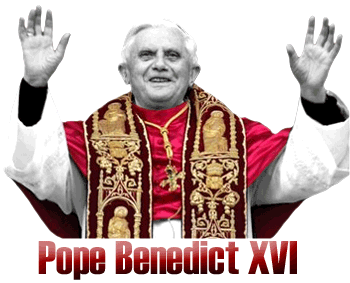
Pope Benedict XVI
VATICAN CITY, APR 19, 2005 (VIS) - Following is the official biography of the newly elected Pope Benedict XVI, Cardinal
Joseph Ratzinger:
Cardinal Joseph Ratzinger, former prefect of the Congregation for the Doctrine of the Faith, President of the Pontifical
Biblical Commission and of the International Theological Commission, Dean of the College of Cardinals, was born on April 16,
1927 in Marktl am Inn, Germany. He was ordained a priest on June 29, 1951.
His father, a police officer, came from a traditional family of farmers from Lower Bavaria. He spent his adolescent years
in Traunstein, and was called into the auxiliary anti-aircraft service in the last months of World War II. From 1946 to 1951,
the year in which he was ordained a priest and began to teach, he studied philosophy and theology at the University of Munich
and at the higher school in Freising. In 1953 he obtained a doctorate in theology with a thesis entitled: "The People and
House of God in St. Augustine's doctrine of the Church." Four years later, he qualified as a university teacher. He then taught
dogma and fundamental theology at the higher school of philosophy and theology of Freising, in Bonn from 1959 to 1969, in
Munster from 1963 to 1966, and in Tubinga from 1966 to 1969. From 1969, he was professor of dogmatic theology and of the history
of dogma at the University of Regensburg and vice president of the same university.
He was already well known in 1962 when, at Vatican Council II at the age of 35, he became a consultor to Cardinal Joseph
Frings, archbishop of Cologne. Among his numerous publications, a particular post belongs to the "Introduction to Christianity,"
a collection of university lessons on the profession of apostolic faith, published in 1968; and to "Dogma and Revelation"
an anthology of essays, sermons and reflections dedicated to the pastoral ministry, published in 1973.
In March 1977, Paul VI appointed him Archbishop of Munich and Freising and on May 28, 1977 he was consecrated - the first
diocesan priest after 80 years to take over the pastoral ministry of this large Bavarian diocese.
Created and proclaimed cardinal by Paul VI in the consistory of June 27, 1977, he assumed the titles of the suburbicarian
Church of Velletri-Segni (April 5, 1993) and of the suburbicarian Church of Ostia (November 30, 2002).
On November 25, 1981 he was nominated by John Paul II as prefect of the Congregation for the Doctrine of the Faith; and
as president of the Biblical Commission and of the Pontifical International Theological Commission.
He was relator of the 5th General Assembly of the Synod of Bishops (1980).
He was president delegate to the 6th Synodal Assembly (1983).
Elected vice dean of the College of Cardinals November 6, 1998, the Holy Father approved his election, by the order of
cardinal bishops, as dean of the College of Cardinals on November 30, 2002.
As President of the Commission for the Preparation of the Catechism of the Catholic Church, after 6 years of work (1986-92)
he presented the New Catechism to the Holy Father.
He received an honoris causa degree in jurisprudence from the Free University of Maria Santissima Assunta on November 10.
1999. He became an honorary member of the Pontifical Academy of Sciences, November 13, 2000.
Curial Memberships as a Cardinal:
- Secretariat of State (second section).
- Oriental Churches, Divine Worship
and Discipline of the Sacraments, Bishops, Evangelization of Peoples, Catholic Education (congregations).
- Christian
Unity (council).
- Latin America, Ecclesia Dei (commissions).
I PRAY THAT HE CAN FOLLOW IN JOHN PAUL II TEACHING
March 25
Feast of the Annunciation
to the Mother of God
"And the angel said to her, 'Do not
be afraid, Mary, for you have found favor with God. And behold, you will conceive in your womb and bear a son, and you shall
call his name Jesus. He will be great and will be called the Son of the Most High. And the Lord God will give to him the throne
of his father David, and he will reign over the house of Jacob forever, and of his kingdom there will be no end.'"
(Luke 1:30-33)
| ~This Great Priest Is Pro- Life~ |
|
|
What A Great Priest Father Frank Pavone Is.
~I'M PRO-LIFE AND AGAINST ANY KIND OF ABORTION~
AND AGAINST SAME SEX MARRIAGES.....
I WOULD LIKE YOU TO SEE PICTURES OF BABIES WHO WERE ABORTED...CLICK ON THE
LINKS BELOW IF YOU CAN.GOD HAVE MERCY ON THEM......
The Roots of Purgatory
All Christians agree that we won’t be sinning in heaven. Sin and final glorification
are utterly incompatible. Therefore, between the sinfulness of this life and the glories of heaven, we must be made pure.
Between death and glory there is a purification.
Thus, the Catechism of the Catholic Church states: "All who
die in God’s grace and friendship, but still imperfectly purified, are indeed assured of their eternal salvation; but
after death they undergo purification, so as to achieve the holiness necessary to enter the joy of heaven. The Church gives
the name purgatory to this final purification of the elect, which is entirely different from the punishment of the damned"
(CCC 1030–1).
The concept of an after-death purification from sin and the consequences of sin is also stated
in the New Testament in passages such as 1 Corinthians 3:11–15 and Matthew 5:25–26, 12:31–32.
The
doctrine of purgatory, or the final purification, has been part of the true faith since before the time of Christ. The Jews
already believed it before the coming of the Messiah, as revealed in the Old Testament (2 Macc. 12:41–45) as well as
in other pre-Christian Jewish works, such as one which records that Adam will be in mourning "until the day of dispensing
punishment in the last years, when I will turn his sorrow into joy" (The Life of Adam and Eve 46–7). Orthodox
Jews to this day believe in the final purification, and for eleven months after the death of a loved one, they pray a prayer
called the Mourner’s Kaddish for their loved one’s purification.
The Eucharist (CCC 1322–1419)
Once we become members of Christ’s family, he does not let
us go hungry, but feeds us with his own body and blood through the Eucharist. In the Old Testament, as they prepared for their
journey in the wilderness, God commanded his people to sacrifice a lamb and sprinkle its blood on their doorposts, so the
Angel of Death would pass by their homes. Then they ate the lamb to seal their covenant with God.
This lamb prefigured
Jesus. He is the real "Lamb of God," who takes away the sins of the world (John 1:29). Through Jesus we enter into a New Covenant
with God (Luke 22:20), who protects us from eternal death. God’s Old Testament people ate the Passover lamb. Now we
must eat the Lamb that is the Eucharist. Jesus said, "Unless you eat my flesh and drink my blood you have no life within you"
(John 6:53).
At the Last Supper he took bread and wine and said, "Take and eat. This is my body . . . This is my blood
which will be shed for you" (Mark 14:22–24). In this way Jesus instituted the sacrament of the Eucharist, the sacrificial
meal
The Primacy of Peter
A lot has been written about the primacy of peter. I present a point of view which is difficult for any
detractor to refute. There is a law in Bible study called 'The Law of First Mention'. It means, the first time something is
mentioned in the Bible, the same meaning holds true for that subject in all subsequent verses in which it is mentioned. This
law helps to hold the harmony and integrity of scripture. GOD is eternal and unchanging, therefore what he said in Genesis
has the same meaning for all chapters.
The 'Primacy of Peter' has been disputed by detractors on many points. Peter was given the primacy in
Matt 16:18, "AND I SAY TO THEE, THOU ART PETER, AND UPON THIS ROCK I WILL BUILD MY CHURCH." Some say Peter was not the 'rock'.
Others try to separate Peter from the Bishop of Rome, by trying to show he was never in Rome. Still others say the words 'I WILL' in Matt 16:18, denotes some future tense. They include Matt 16:19, "I WILL give thee
the keys..." as 'proof' that Peter did not receive the keys, but somehow ALL the Apostles received them in Matt 18:18. It
is obvious that Jesus spoke to Peter alone in Matt 16:19 and gave him personally, the power of binding and loosening. It is
also obvious that Jesus again gave him the power of binding and loosening along with the other Apostles in Matt 18:18, and
yet again in John 20:23. However, Jesus gave Peter and Peter alone, the Keys of the Kingdom of Heaven in Matt 16:19. Detractors
of the primacy of Peter have arguments that are so weak, they are almost non-existent. I could discuss each of these points,
but in this section of this letter I will discuss only one point, which makes all other arguments against the primacy of Peter
moot.
The Law of First Mention...
When something is first mentioned in the Bible, the meaning of it remains the same throughout the rest
of the Bible.
When GOD gave authority to someone in Scripture, HE changed the name of that person.
1. GOD renamed Abram to Abraham when He made him the 'Father of a Multitude of Nations', in Gen 17:5.
HE gave Abraham 'primacy' over all other men.
2. GOD renamed Sara to Sarah when HE made her the 'Mother of Nations' in Gen 17:15-16. HE gave Sarah
'primacy' over all other women.
3. GOD renamed Jacob to Israel, the name of the Jewish Nation, and Jacob became the first Israeli in
Gen 32:29, 35:10.
4. GOD renamed Simon to Peter in Matt 16:18, thus giving him 'primacy' over all of the Apostles. Why
else would GOD give a new name to Simon?
The 'Law of First Mention' as applied to Abraham, Sarah, and Israel, works very well indeed. Why then
do some believe it does not work for Simon-Peter?
Matthew 16:13-17...
Jesus said, "Who do men say the Son of Man is?" (13)
But they said, "Some say, John the Baptist; and others Elias; and others Jeremias,
or one of
the prophets." (14)
He said to them, "But who do YOU say that I am?" (15)
Simon
Peter answered and said, "Thou art the Christ, the Son of the Living GOD." (16)
Then Jesus answered
and said, "Blessed art thou, Simon Bar-Jona, for flesh and blood has
not revealed this to thee, but
My Father in Heaven." (17)
This verse expresses a blessing for Peter from the Son.
Did
you notice that Peter was the only Apostle who knew who Jesus Christ was?
All of the rest expressed an opinion.
GOD
the Father, Himself, told Peter alone, and not one of the other Apostles.
It was a blessing for Peter from the Father.
This
is a clear sign of the Primacy of Peter from the Father.
John 21:1-11... There are at least three examples of the primacy of Peter in these verses. In verse 2-3, seven
of the disciples are gathered together when Peter makes a decision to go fishing. The others agreed to go with him. They fished
all night and caught nothing, as usual. Jesus told them where to cast the net, they did, and caught so many fish, all of them
together could not draw the net up (verse 6). John, the disciple whom Jesus loved, told Peter (he informed Peter first) that
it was the Lord standing on the beach. Peter jumped off into the sea after hearing of this (verse 7). The other six disciples
came with the boat, dragging the net full of fishes. In verse 10, Jesus asked that they bring some of the fishes to Him. In
verse 11, it was Peter alone who hauled the net full of 153 large fishes onto land. Now, how much did 153 large fishes weigh?
We do not know the average weight of each but since they were large, even at only three pounds each, they totaled over 450
pounds and yet Peter alone managed to haul them ashore when all seven disciples could not draw up the net in verse 6. This
clearly shows the super human power of Peter. Once again, the presence of Jesus allowed them to make a huge catch, and after
knowing it is the Lord, Peter suddenly has super human power to bring in the catch alone. John 21:15-17... Three
times in these verses Jesus Christ tells Peter to "Feed My Sheep", or to "Feed My Lambs". For proper understanding of these
verses it is necessary to refer to the underlying Greek text. In verse 16,
the Greek word used for "feed" is "poimaino" (second person singular), which means, to act as a SHEPHERD, to rule, to govern,
to pastor, or the presiding officer. It is the only time this Greek word is used in the Gospel of John. In verses 15 and 17,
the Greek word used for "feed" is "bosko", which means to feed. So verses 15-17 say 'feed my lambs, shepherd my lambs, and
feed my sheep'. Jesus told Peter alone to be the SHEPHERD of His flock.
In John 10:16, Jesus said, "...and
there shall be one fold and ONE SHEPHERD." The Greek word used here is "poimen (masculine,
singular)". Clearly, Jesus said in these verses that there will be only ONE SHEPHERD, and that shepherd will be Peter,
the first Bishop of Rome and the first Pope.
Acts 15:7, during the first Church Council, the Council of Jerusalem...
And after a long debate,
Peter got up and said to them,
"Brethren, you know that in early days GOD made choice among us, that
through MY mouth the Gentiles should hear the word of the Gospel and believe."
Who made the
choice? GOD did. Who did GOD choose? He chose Peter. Now that is primacy.
Some detractors of Peter's primacy try to
show that James (Acts 15:13-21), held the primacy simply because he was the Bishop of Jerusalem. Well, he may have been the
Bishop of Jerusalem during this Council, but Peter was the Bishop of the whole world. See Acts 1:8, where Jerusalem was only
one of many Church locations to be founded by the Apostles. The books of Acts, Revelation, and a few others, record more than 30 additional
locations for the Church other than Jerusalem.
Jerusalem
would certainly not even have been considered by the Apostles to be the seat of Christianity, as they had been forewarned
by Jesus Himself that the city would soon be totally destroyed. This prophecy was fulfilled in 70 A.D. when Roman legions
did indeed destroy it.
See Matthew 24 beginning with verse 15.
Eusebius (263-339) Bishop of Caesarea and known as
"The Father of Church History", wrote in 'The History of the Church' volume 2 chapter 1, "But Clement in the sixth book of
his Hypotyposes writes thus: 'For they say that Peter and James and John after the ascension of our Saviour, as if also preferred
by our Lord, strove not after honor, but chose James the Just, bishop of Jerusalem'."
Peters primacy: Matt 10:2,16:15-19, *Luke 22:24-33,24:34, John 10:16,21:1-11,15-19,
Acts 2:14-41,
Acts *5:29,9:36-43,10:1-48,11:1-18, *Acts 15:7, 1Cor 15:5.
The names of Peter, which include Simon and Cephas, are mentioned more times in the New Testament than
any other Apostle.
"Of Peter the most is known. Peter is mentioned 195 times, the rest of the Apostles only 130 times.
The one mentioned next in frequency to Peter is John, to whom there are 29 references."
Archbishop Fulton J. Sheen, "Life
of Christ", page 106.
The name James, is mentioned a total of 38 times and of that number there were 2 persons, James
the Greater, and James the Less. So if James the Less is said to have the primacy, then why is he mentioned so few times compared
to Peter?
Every time the names of the Apostles are listed, except for Gal 2:9, his name appears first. In Mt 10:2 it
even says that Peter is first, "Now these are the names of the twelve Apostles: first Simon, who is called Peter,...".
See also Mk 3:16, Lk 6:13-14, and Acts 1:13.
Peter's name appears first also when 3 or 4 of the Apostles are listed: Mt
17:1, Mk 5:37, Mk 9:2,
Mk 13:3, Mk 14:33, Lk 5:8-10, Lk 8:51, Lk 9:28.
As for Gal 2:9, it was customary then, as it
is to this very day, to name the Bishop of the Diocese first. If the Pope visited a Diocese, the Bishop would be named ahead
of him as it is the proper protocol. In Gal 2, Peter was visiting Jerusalem, as verses 1-8 show.
It never ceases to amaze
me that those who deny the Primacy of Peter, will invariably point to this one and only verse where Peter is named second
and will completely ignore the many verses which list his name first. If James held the primacy as some would like us to believe,
then why is he mentioned first in only one single verse?
Throughout our salvation history, GOD has always provided
a 'Father Figure' to guide His people. Some examples are, Noah, Abraham, Isaac, Jacob, Moses, David, Solomon, and Peter and the succession
of Popes.
WHETHER or not you are Catholic, you may have questions about the Catholic faith. You may have heard challenges to the
Catholic Church’s claim to be the interpreter and safeguard of the teachings of Jesus Christ.
Such challenges
come from door-to-door missionaries who ask, "Are you saved?", from peer pressure that urges you to ignore the Church’s
teachings, from a secular culture that whispers "There is no God."
You can’t deal with these challenges unless
you understand the basics of the Catholic faith. This booklet introduces them to you.
In Catholicism you will find
answers to life’s most troubling questions: Why am I here? Who made me? What must I believe? How must I act? All these
can be answered to your satisfaction, if only you will open yourself to God’s grace, turn to the Church he established,
and follow his plan for you (John 7:17).
We were created to be perfectly happy forever with God. Perfect happiness can only be found in perfect life,
love, and truth which is God. Happiness does not consist in temporary and imperfect material possessions (Lk.12:15),
sensual pleasures (Ec.1:8),and human friendships, but only in perfect and eternal friendship with God. "Seek first the
kingdom of God."(Mt.6:33) Our hearts are restless until they rest in you" St. Augustine

| ~THE MOTHER OF THE CATHOLIC CHURCH~ |
|
|
- Does the liturgy give us any hints about Mary's life?
- Are there any books on Mary's life?
- What are the aspects of Mary’s person and life, which are related by the various apocryphal writings?
- What about Mary's death?
- Who are Mary's parents?
- What do we know about Mary's life from apocryphal sources?
~This Is One Of My Awards~
John Paul II and the Defense of Life
John Paul II has tirelessly pleaded for the right to life of the unborn, the elderly, the sick and the handicapped.
One can hardly forget his passionate call to end abortion on the Capitol Mall, Washington D.C. and in his native Poland.
"I do not hesitate to proclaim before you and before the world that all human life…is sacred, because
human life is created in the image and likeness of God. Nothing surpasses the greatness or dignity of a human person. Human
life is precious because it is the gift of God whose love is infinite; and when God gives life, it is forever. And so, we
will stand up every time that human life is threatened. When the sacredness of life before birth is attacked, we will stand
up and proclaim that no one ever has the authority to destroy unborn life."
(From the address of Pope John Paul II, Capitol Mall, Washington, D.C., October 7, 1979)
He established February 11 as the World Day of Prayer for the Sick, and he has visited the sick during almost
every one of his trips.
In 1994 John Paul publicly objected to the September Cairo Conference on population and development. The
Church’s concern over the conference centered on the possible harm it might deal to human life and family issues because
of family planning programs for poor nations that included contraception and even abortion.
He explained to Mrs. Nafis Sadik, the secretary general for the conference, "The proofs for the final documents
are a source of great concern to me. Some of the proposals contradict basic ethical principles. And this is a discussion of
the future of humanity." The Pope objected that the document did not condemn sterilization and abortion, and it ignored the
institution of matrimony, as if marriage were something that belonged to the past. Further, he complained the document stressed
a limitation of the family rather than its development.
Two documents are especially significant in John Paul’s defense of human life. The first is the Letter
to Families, dated February 22, 1994. Here the Pope criticizes the culture of the West, which has in recent times "passed
laws contrary to the right to life of every human being." Consequently, "we are facing an immense threat to life; not only
to the life of individuals but also to that of civilization itself. The statement that civilization has become in certain
areas a ‘civilization of death’ is being confirmed in disturbing ways."
The second document is the 1995 encyclical Evangelium Vitae (The Gospel of Life), a magisterial synthesis
on the defense of life. The document also contains something new by way of a statement on the death penalty. In spite of the
uninterrupted tradition in its favor, the encyclical opposes the death penalty in order to be consistent with its fundamental
teaching on abortion and euthanasia, and in 1997 he also had a corrected text regarding the death penalty inserted
into the definitive edition of the Catechism of the Catholic Church.
| No ''Open Question'' on Communion for Divorced |

Cardinal Alfonso Lopez Trujillo has flatly denied that there is any uncertainty on whether divorced
and remarried Catholics should receive Communion.
In a rare public disagreement between Vatican prelates, the president of the Pontifical Council
for the Family spoke to the Italian daily La Repubblica just four days after Cardinal Walter Kasper had made the claim
that the proper pastoral policy toward divorced and remarried Catholics remained an open question.
The October meeting of the Synod of Bishops endorsed the existing Church teaching, which bars
Catholics from Communion if they are involved in illicit marital situations. But just after the conclusion of the Synod, Cardinal
Kasper-- the president of the Pontifical Council for Christian Unity-- had told a Rome press conference, "I cannot imagine
that the discussion is closed."
The German prelate had, in 1993, endorsed a policy of allowing divorced and remarried Catholics
to receive Communion in the Rottenberg diocese. That policy was rejected by the Vatican's Congregation for the Doctrine of
the Faith, in a statement signed by then-Cardinal Joseph Ratzinger. Nevertheless, Cardinal Kasper hinted that Pope Benedict
XVI might now choose to set aside the Synod's recommendation on the same issue.
Cardinal Lopez Trujillo emphatically disagreed, in his interview with La Repubblica. "The
Synod," he said, "did not leave any doubt about the Church's doctrine. This is not a case in which there is an open question."
"All these remarks about an 'open question'-- as if the door has been left open for future, creating
the expectation of a possible change-- do not seem acceptable to me," he said. The Colombian cardinal said that from a doctrinal
perspective, the reason for the Church policy is evident; he observed that "the very Word of God regarding the indissolubility
of marriage is sufficient." The Catechism is equally clear, he pointed out. He explained: "Those who say they are divorced
and remarried-- because their [second] marriage is not a true marriage-- are in an objective situation which is contrary to
the law of God, and does not allow them to approach Communion."
Cardinal Lopez Trujillo called attention to the fact that the question of Communion for divorced
Catholics had already been raised by then-Bishop Kasper, along with two other German bishops, in the 1990s. The German bishops'
policy was overturned, he observed, by Cardinal Ratzinger, with the explicit approval of Pope John Paul II. "You cannot put
the current Pope in contradiction with Cardinal Ratzinger," he said.
The Colombian prelate concluded that "no modification of this doctrine is possible." He added:
"This is not a question that is in debate, or can be debated."
Clearly hoping to ease a conflict with his Vatican colleague, Cardinal Lopez Trujillo told La
Repubblica that Cardinal Kasper is "a great theologian." He suggested that perhaps the German cardinal had sought to accentuate
the pastoral needs of the couples who are divorced and remarried, and "what he said was not well understood."
The president of the Pontifical Council for the Family also noted that it is possible for divorced
and remarried Catholics to receive Communion "if they are living as brother and sister, without sexual relations."
Courtesy of Catholic World News | |
The Catholic Church teaches that the sacrifice of Christ on the cross occurred "once for all"; it cannot be repeated (Heb.
9:28). Christ does not "die again" during Mass, but the very same sacrifice that occurred on Calvary is made present on the
altar. Thats why the Mass is not "another" sacrifice, but a participation in the same, once-for-all sacrifice of Christ on
the cross.as jesus said my father is in me and I'm in my father. jesus is the big oak tree,and we are the branches.we are
one as the church is one.
A Crisis of Saints
By Fr. Roger Landry
April 2002
Headlines were captured in February by the tragic reports
that as many as seventy priests in the Archdiocese of Boston, Massachusetts, allegedly have abused young people whom they
were consecrated to serve. In the wake this news, allegations of sexual abuse by Catholic priests have sprung up nationwide.
It is a huge scandal, one that many people who dislike the Catholic Church because of its moral teachings are using to claim
that the Church is hypocritical and that they were right all along. Many people have come up to priests like myself to talk
about it. I imagine many others have wanted to but have refrained out of respect or from not wanting to bring up bad news.
We
need to tackle the issue head-on. Catholics have a right to it from their clergy. We cannot pretend it doesn't exist, and
I would like to discuss what our response as faithful Catholics should be to this terrible situation.
The Judas
syndrome
The first thing we need to do is to understand this scandal from the perspective of our faith in the Lord.
Before he chose his first disciples, Jesus went up the mountain to pray all night (Luke 6:12). He had many followers at the
time. He talked to his Father in prayer about whom he should choose to be his twelve apostles-the twelve whom he would form
intimately, the twelve whom he would send out to preach the good news in his name. He gave them power to cast out demons.
He gave them power to cure the sick. They watched him work countless miracles. They themselves worked countless others in
his name.
Yet one of them tuned out to be a traitor. One who had followed the Lord-who had seen him walk on water and
raise people from the dead and forgive sinners, one whose feet the Lord had washed-betrayed him. The gospels tells us that
Judas allowed Satan to enter into him and then sold the Lord for thirty pieces of silver, handing him over by faking a gesture
of love. "Judas," Jesus said to him in the garden of Gethsemane, "would you betray the Son of Man with a kiss?" (Luke 24:48).
Jesus
didn't choose Judas to betray him. But Judas was always free, and he used his freedom to allow Satan to enter into him, and
by his betrayal Jesus was crucified and executed. But God foresaw this evil and used to accomplish the ultimate good: the
redemption of the world.
The point is, sometimes God's chosen ones betray him. That is a fact that we have to confront.
If the early Christians had focused only on the scandal caused by Judas, the Church would have been finished before it even
started to grow. Instead they recognized that you don't judge a movement by those who don't live it but by those who do. Rather
than focusing on the betrayer, they focused on the other eleven on account of whose work, preaching, miracles, and love for
Christ we are here today. It is on account of the other eleven-all of whom except John were martyred for Christ and for the
gospel they proclaimed-that we ever heard the saving word of God, that we ever received the sacraments of eternal life.
We
are confronted by the same scandalous reality today. We can focus on those who have betrayed the Lord, those who abused rather
than loved the people whom they were called to serve. Or we can focus, as did the early Church, on those who have remained
faithful, those priests who are still offering their lives to serve Christ and you out of love. The secular media almost never
focuses on the good "eleven," the ones whom Jesus has chosen who remain faithful, who live lives of quiet holiness. But we
the Church must keep the terrible scandal that we are witnessing in its true and full perspective.
Russian Orthodox Church Backs Vatican on Gay Seminarians
Saturday,
December 10, 2005 12:00:00 AM GMT
The Russian Orthodox
Church has issued a statement of support for the Vatican's Instruction barring the admission of homosexual men to seminaries.
Father Igor Vyzhanov, a spokesman for the Moscow Patriarchate, told the Interfax news agency that while the Russian
Orthodox Church differs with Catholicism insofar as married men may be ordained in the Eastern Church, the world's two largest
Christian bodies "have a common approach to the problem of homosexuality."
The Bible, Father Vyzhanov observed, condemns
homosexual acts in terms that "do not leave any room for a different interpretation." He said that Orthodox believers have
trouble comprehending Protestant groups that have given their blessing to same-sex unions.
The Orthodox Church spokesman
said that exclusion of homosexuals from seminaries and from the priesthood should be a common policy, since homosexuality
can never be accepted as normal, and those who have same-sex attraction must be understood to "suffer from a serious illness."
|
Trinitarianism and other Christian conceptions===
To [[Trinitarianism|trinitarian]] Christians (which for many centuries
has represented the vast Christian majority), God the Father is not at all a separate god from the Son (of whom [[Jesus]]
is the incarnation) and the [[Holy Spirit]], the other members of the [[Godhead (Christianity)|Christian Godhead]]. Trinitarian
Christians describe these three persons as a [[Trinity]]. This means that they always exist as three distinct "persons" (Greek
''hypostases''), but they are one God, each having full identity as God himself (a single "substance"), a single "divine nature"
and power, and a single "divine will".
Other Christians, however, have held a very diverse variety of alternative ideas.
A handful have described the Father, Jesus Christ and Spirit as each a distinct, eternally existent being ([[tritheism]]),
or as a different "manifestation" of a single being ([[modalism]]). Some have theorized that the relationship of Father and
Son began at some point probably outside of normal "history" ([[Arianism]]); and others have believed that God became a Father
when he uttered his creating Λογος ("logos" or "word"), who is both
a principle of order and a living being to whom God bears the relationship as Father (some [[gnosticism|gnostics]]). Others
found strong affinity with traditional [[paganism|pagan]] ideas of a savior or hero who is begotten by deity, an idea of the
Father similar to [[Mithraism]] or the cult of the Roman emperor.
For most Christians, the person of God the Father is
the ultimate, and on occasion the exclusive addressee of prayer, often in the ''name of'' Jesus Christ. The [[Lord's Prayer]],
for example, begins, "Our Father who art in Heaven...."
In the New Testament, God the Father has a special role in his
relationship with the person of the Son, where Jesus is believed to be his Son and his heir (Hebrews 1:2-5). According to
the Nicene Creed, the Son (Jesus Christ) is "eternally begotten of the Father", indicating that their ''divine'' Father-Son
relationship is not tied to an event within time or human history. ''See'' [[Christology]].
In [[Eastern Orthodox]] theology,
God the Father is the "source" or "origin" of both the Son and the Holy Spirit; in Western theology, all three hypostases
or persons have their origin in the divine nature instead. The Cappadocian Fathers used this Eastern Orthodox monarchian understanding
to explain why trinitarianism is not tritheism: "God is one because the Father is one," said [[Basil the Great]] in the fourth
century. In the eighth century, [[John of Damascus]] wrote at greater length about the Father's role:
: ''Whatsoever the
Son has from the Father, the Spirit also has, including His very being. And if the Father does not exist, then neither does
the Son and the Spirit; and if the Father does not have something, then neither has the Son or the Spirit. Furthermore, because
of the Father, that is, because of the fact that the Father is, the Son and the Spirit are; and because of the Father, the
Son and the Spirit have everything that they have.''
|
|
|
JESUS CHRIST'S DIVINITY -
SOME OF MANY EXAMPLES
Scripture
- Old and New Testament Parallels of God the Father and God the Son
- Jesus Christ's Witnesses Claim that Jesus is God
- Jesus Christ Claims to be God
- Jesus' Miracles Testify that He is God
- Jesus Christ is Worshiped
Tradition / Church Fathers
- Jesus is God the Son
- God is One in Three Divine Persons
Back · Home · Next
|
 |
Scripture
I. Old and New Testament Parallels of God the Father and God the Son
Exodus 3:14 - God says "I AM who I AM" - John 8:58 - Jesus says "Before Abraham was, I AM" in reference to Himself.
Deut. 4:2; 12:32 - the Lord God commands that we not add or take away from His word - Rev. 22:18-19 - Jesus so commands
us not to add or take away from His word.
Deut. 32:39; 1 Sam. 2:6 - the Lord kills and makes alive again and raises up - John 5:21 - the Son raises and gives life.
Deut. 32:39 - neither is there any that can deliver out of God's hand - John 10:28 - nor shall any pluck out of Jesus'
hand.
Deut. 32:43 - rejoice, ye heavens, with Him, and let all the angels of God worship Him - Heb. 1:6 - the "Him" is Jesus
the Son.
2 Sam. 22:3 - God is the horn of salvation - Luke 1:68-69 - Jesus is the horn of salvation.
Psalm 19:7 - the law of the Lord is perfect - Gal. 6:2 - fulfill the law of Christ.
Psalm 24:10 - the Lord is the King of glory - 1 Cor. 2:8 - Jesus is the Lord of glory.
Psalm 45:7 - Therefore God, your God, has anointed you. God calls someone else God. This someone else is His eternally
begotten Son - Heb. 1:9 - Therefore God, your God, has anointed you. cf. Heb. 1:8, 10.
Psalm 62:12 - the Lord God renders to each according to his work - Matt. 16:27; Rev. 22:12 - Jesus so renders to each according
to his work.
Psalm 71:5 - the Lord God is our hope - 1 Tim. 1:1 - the Lord Jesus Christ who is our hope.
Psalm 89:27 – I will make him the first-born, the highest (“elyon” which refers to God) of the kings
of the earth - John 18:36-27 – Jesus is this first-born king.
Psalm 97:9 - the Lord God is above all - John 3:31 - Jesus is above all.
Psalms 110:1 - the Lord (Yahweh) said to my Lord - Jesus = Yhwh - Acts 2:34-36 - God has made Jesus both Lord and Christ.
Psalm 148:1-2 - the angels worship the Lord God - Heb. 1:6 - the angels worship Jesus. Only God is worshiped.
Prov. 3:12 - who the Lord loves He corrects - Rev. 3:19 - who Jesus loves He corrects.
Isaiah 7:14 - a virgin will bear a Son named Emmanuel which means "God is with us" - Matt. 1:23 - this Son is Jesus Christ,
God in the flesh.
Isaiah 9:6 - the child to be born shall be called Wonderful Counselor, Mighty God, Everlasting Father, Prince of Peace.
Isaiah 25:8 - God swallows up death in victory - 2 Tim. 1:10 - Jesus abolishes death and brings life and immortality.
Isaiah 40:8 - the Word of God shall stand forever - Matt. 24:35 - the Words of Jesus shall not pass away.
Isaiah 42:8 - God gives His glory to no other - John 17:5; Heb. 1:3 - yet Jesus has the same glory as the Father.
Isaiah 43:14 - the Lord God is redeemer - Titus 2:14 - Jesus is the redeemer.
Isaiah 44:6 - the Lord God is the first and the last - Rev. 1:17; 2:8; 22:13 - Jesus is the first and the last.
Isaiah 45:19 - I, the Lord God, did not speak in secret - John 18:20 - Jesus said "I have said nothing secretly."
Isaiah 45:23 - to God, every knee shall bow and every tongue swear. Phil. 2:10-11 - at Jesus' name every knee should bow
and tongue confess.
Isaiah 48:17 - God is the Holy One - Acts 3:14 - Jesus is the Holy One.
Isaiah 60:19 - God is everlasting light - Revelation 21:23 - Jesus the Lamb is eternal light.
Jer. 17:10 - the Lord searches the hearts and repays us according to our deeds - Rev. 2:23 - Jesus searches the hearts
and repays us according to our deeds.
Ezek. 1:26-28; Daniel 7:9 - God's glorious appearance - Rev. 1:13-16 - Jesus' glorious appearance.
Ezek. 34:11-31 - God the Father is the shepherd of the flock - John 10:7-29 - Jesus is the shepherd of the flock.
Ezek. 34:16 - God seeks to save that which was lost - Luke 19:10 - Jesus seeks to save that which was lost.
Ezek. 34:17 - God judges between cattle, rams and goats - Matt. 25:32 - Jesus judges and separates the goats from the sheep.
Ezek. 43:2 - God's voice was like a noise of many waters - Rev. 1:15 - Jesus' voice was like the sound of many waters.
Dan. 2:47 - the Lord is the God of gods and the Lord of Lords - Rev. 17:14 - Jesus the Lamb is the Lord of Lords.
Top
|
|
II. Jesus Christ's Witnesses Claim that Jesus is God
John 1:1 - John writes, "the Word was God." This is clear evidence of Jesus Christ's divinity. (Note: in the Jehovah's
bible, the passage was changed to "Word was a god." This is not only an embarrassing attempt to deny the obvious divinity
of Christ, but it also violates the first commandment and Isaiah 43:10 because it acknowledges that there is more than one
God).
John 1:2-3 - He (the Word) was in the beginning with God and all things were made through Him (the Word who was God).
John 1:14 - the Word (who is God) became flesh (Jesus) and dwelled among us, full of grace and truth.
John 1:18 - the Greek word for "only-begotten" is "monogenes" which means unique, only member of a kind. It does not mean
created.
John 1:51 - the angels of God - Matt. 13:41 - Son of Man's angels; 2 Thess. 1:7 - Jesus will be revealed from heaven with
His angels.
John 3:5 - Jesus says without baptism one cannot enter into the Kingdom of God - Col. 1:13 - Paul says this is Jesus' Kingdom.
John 6:68-69 - Peter confesses that Jesus is the Son of God who has the words of eternal life.
Acts 2:36 - God has made Jesus both Lord and Christ - Acts 4:24 - Sovereign Lord who made heaven and earth. This means
Jesus is God.
Acts 3:15 - Peter said the men of Israel "killed the Author of Life." This can only be God - Acts 14:15 - who made all
things.
Acts 20:28 - to care for the Church of God which He obtained with His own blood. This means God shed His blood. When? When
He died on the cross. This means Jesus is God.
Rom. 1:1 - Paul is an apostle of the Gospel of God - Rom. 15:19 - Paul preached the Gospel of Christ.
Rom. 7:22 - Paul says he delights in the law of God - Gal. 6:2 - Paul says fulfill the law of Christ.
Rom. 8:9 - Paul refers to both the Spirit of God and the Spirit of Christ.
Rom. 9:5 - Jesus Christ is God over all, blessed forever.
Rom. 11:36 - God for from Him through Him and to Him are all things - Heb. 2:10 - Jesus for whom and by whom are all things.
1 Cor. 15:9 - Paul says he persecuted the Church of God - Matt. 16:18; Rom. 16:16 - it is the Church of Jesus Christ.
1 Cor. 15:28 - God may be all in all - Colossians 3:11 - Christ is all and in all.
Gal. 1:5 - God the Father to whom be the glory forever - 2 Peter 3:18 - to Jesus Christ be the glory both now and forever.
Phil. 2:6-7 - Jesus was in the form of God, but instead of asserting His equality with God, emptied Himself for us.
Col. 1:15 - Jesus is the image of the invisible God, the "firstborn" of all creation. The Greek word for "first-born" is
"prototokos" which means eternal preexistence (it never means created).
Col. 1:26 - God's saints - 1 Thess. 3:13 - at the coming of Jesus Christ with all His saints.
Col. 2:9 - in Jesus Christ the whole fullness of deity dwells bodily. He is the whole and entire fullness of the indivisible
God in the flesh.
Titus 1:1 - Paul says he is a servant of God - Rom. 1:1 - Paul says he is a servant of Jesus Christ.
Titus 1:3-4 - God our Savior = Christ our Savior = Jesus Christ is God.
Titus 2:11 - the grace of God that has appeared to save all men - Acts 15:11 - through the grace of Jesus we have salvation.
Titus 2:13 - we await our blessed hope, the appearing of the glory of our great God and Savior Jesus Christ.
Titus 3:4 - 3:6 - great God and Savior Jesus Christ = God our Savior = Jesus Christ our Savior = Jesus is God.
Heb. 1:6 - when God brings His first-born into the world, let all the angels of God worship Him. Only God is worshiped.
Heb. 1:8 - God calls the Son "God." But of the Son He says, "Thy Throne Oh God is forever and ever."
Heb. 1:9 - God calls the Son "God." "Therefore, God, Thy God has anointed Thee."
Heb. 1:10 - God calls the Son "Lord." "And thou, Lord, didst found the earth in the beginning and the heavens are your
work."
Heb. 13:12 - Paul says Jesus sanctifies the people with His blood - 1 Thess. 5:23 - the God of peace sanctifies the people.
2 Peter 1:1 - to those who have obtained a faith of equal standing in the righteousness of our God and Savior Jesus Christ.
1 John 5:20 - "that we may know Him who is true, in His Son Jesus Christ. This is the true God and eternal life."
Jude 4 - Jude calls Jesus Christ our only Master and Lord. Our only Master and Lord is God Himself.
Rev. 2:8 - the angel of the church in Smyrna wrote, "The words of the First and the Last, who died and came to life." See
Isa. 44:6.
Rev. 22:6 - the Lord God sends angels - Rev. 22:16 - Jesus sends angels.
Top
|
|
III. Jesus Christ Claims to be God
Matt. 4:7; Luke 4:12 - Jesus tells satan, "you shall not tempt the Lord your God" in reference to Himself.
Matt. 5:21-22; 27-28; 31-32; 33-34; 38-39; 43-44 - Jesus makes Himself equal to God when He declares, "You heard it said...but
I say to you.."
Matt. 7:21-22; Luke 6:46 - not everyone who says to Jesus, "Lord, Lord." Jesus calls Himself Lord, which is God.
Matt. 9:2; Mark 2:5; Luke 5:20; 7:48 - Jesus forgives sins. Only God can forgive sins.
Matt. 12:8; Mark 2:28; Luke 6:5 - Jesus says that He is "Lord of the Sabbath." He is the Lord of God's law which means
He is God.
Matt. 18:20 - Jesus says where two or three are gathered in His name, there He is in the midst of them.
Matt. 21:3; Luke 19:31,34 - Jesus calls himself "Lord." "The Lord has need of them."
Matt. 26:64; Mark 14:62; Luke 22:70 - Jesus acknowledges that He is the Son of God.
Matt. 28:20 - Jesus said He is with us always, even unto the end of the world. Only God is omnipresent.
Mark 14:36 - Jesus calls God "Abba," Aramaic for daddy, which was an absolutely unprecedented address to God and demonstrates
Jesus' unique intimacy with the Father.
Luke 8:39 - Luke reports that Jesus said "tell how much God has done for you." And the man declared how much Jesus did.
Luke 17:18 - Jesus asks why the other nine lepers did not come back to give praise to Him, God, except the Samaritan leper.
Luke 19:38,40 - Blessed is He who comes in the name of the Lord. If these were silent, the very stones would cry out.
John 5:18 - Jesus claimed to be God. The Jews knew this because Jesus called God His Father and made Himself equal to God.
This is why Jesus was crucified.
John 5:21-22 - Jesus gives life and says that all judgment has been given to Him by the Father.
John 5:23 - Jesus equates Himself with the Father, "whoever does not honor the Son does not honor the Father who sent Him."
John 6:38 - Jesus says, "For I have come down from heaven."
John 8:12 - Jesus says "I am the light of the world." - 1 John 1:5 - God is light and in him there is no darkness at all.
John 8:19 - Jesus says, "if you knew me, you would know my Father also."
John 8:23 - Jesus says that He is not of this world. Only God is not of this world.
John 8:58 - Jesus says, "Before Abraham was, I AM." Exodus 3:14 - "I AM" means "Yahweh," which means God.
John 10:18 - Jesus says He has the power to lay down His life and take it up again - Gal. 1:1 - God raised Jesus to life.
John 10:30 - Jesus says, "I and the Father are one." They are equal. The Jews even claimed Jesus made Himself equal to
God. Jesus' statement in John 14:28, "the Father is greater than I," cannot contradict John 10:30 (the Word of God is never
in conflict). Jesus' statement in John 14:28 simply refers to His human messianic role as servant and slave, which He, and
not the Father or the Holy Spirit, undertook in the flesh.
John 10:36 - again, Jesus claims that He is "the Son of God."
John 10:38; 14:10 - "the Father is in me and I am in the Father" means the Father and Son are equal.
John 12:45 - Jesus says, "He who sees Me sees Him who sent Me." God the Father is equal to God the Son.
John 13:13 - Jesus says, "You call me Teacher and Lord and you are right for so I AM."
John 14:6 - Jesus says "I am the way, and the truth and the life." Only God is the way, the truth and the life.
John 16:15 - Jesus says, "all things that the Father has are Mine." Jesus has everything God has which makes Him God.
John 16:28 - Jesus says that "He came from the Father and has come into the world."
John 17:5,24 - Jesus' desire is for us to behold His glory which He had before the foundation of the world.
John 20:17 - Jesus distinguishes His relationship to the Father from our relationship by saying "My Father and your Father."
Rev. 1:8 - God says He is the "Alpha and the Omega." In Rev. 22:13, Jesus also says He is the "Alpha and Omega, the First
and the Last, the beginning and the end." The only possible conclusion one can reach is that Jesus is equal to the Lord God.
Rev. 1:17 - Jesus says again, "I am the First and the Last." This is in reference to the God prophesied by Isaiah in Isaiah
44:6, 41:4, 48:12.
Rev. 1:18 - Jesus, the First and the Last, also says "I died, and behold, I am alive for evermore." When did God ever die?
He only did in the humanity of Jesus Christ our Lord and God.
Rev. 2:8 - Jesus again says, "The words of the First and the Last, who died and came to life." When did God die and come
to life? In our Lord and Savior Jesus Christ.
Top
|
|
IV. Jesus' Miracles Testify that He is God
Matt. 1:23; Mark 1:27,35 - Jesus was conceived in the virginal womb of the Blessed Mother.
Matt. 3:16-17; Mark 1:10-11; John 1:32 - God's Spirit descends upon Jesus and the Father declares Jesus to be His Son.
Matt. 4:23-24; 9:35;15:30; Mark 1:34; 3:10; 6:5; Luke 4:40; 7:10; 13:13; 14:4; John 4:52 - Jesus miraculously cures illness
and disease.
Matt. 7:35 - Jesus cures a deaf person with a speech impediment.
Matt. 8:3; Mark 1:41; Luke 5:13; 17:14 - Jesus cures leprosy.
Matt. 9:21-22; Mark 5:27-34; Luke 8:44 - the hem of Jesus' cloak cures the woman with the hemorrhage. See also Matt. 14:36.
Matt. 8:13; 9:7; Mark 2:9; Luke 5:25 - Jesus cures those who are paralyzed.
Matt. 8:15; Mark 1:31; Luke 4:39 - Jesus cures Peter's mother-in-law's fever.
Matt. 8:26; Mark 4:39; Luke 8:24 - Jesus calms the storm. Even the wind and sea obey Him.
Matt. 8:32; 9:33; 12:22; 15:28; 17:18; Mark 1:26,34; 3:11; 5:13; 7:30; 9:26; Luke 4:35,41; 8:33; 9:42; 11:14 - Jesus has
power over demons.
Matt. 9:4; 12:25; Luke 6:8; 11:17 - Jesus knows people's thoughts.
Matt. 9:25; Mark 5:24; John 11:44 - Jesus raises people from the dead.
Matt. 9:30; 12:22; 20:34; 21:14; Mark 8:25; 10:52; Luke 7:21; 18:42; John 9:11 - Jesus cures the blind.
Matt. 12:13; Mark 3:5; Luke 6:10 - Jesus cures the man with the withered hand.
Matt. 14:19-20; 5:36-37; Mark 6:41-42; 8:7-8; Luke 9:16-17; John 6:11 - Jesus multiplies the loaves and fish and feeds
the crowd of thousands.
Matt. 14:26; Mark 6:48; John 6:19 - Jesus walks on water.
Matt. 15:21; 16:21; 17:9,22; 20:18-19; 26:2; Mark 10:33-34; Luke 9:44; 17:25; 18:32-34 - Jesus predicts His passion.
Matt. 17:2; Mark 9:2; Luke 9:29 - Jesus is transfigured in glory.
Matt. 17:27 - Jesus miraculously has a shekel appear in the mouth of a fish.
Matt. 21:2-3; Mark 11:2; Luke 19:30 - Jesus predicts that a colt would be available for Him.
Matt. 21:19; Mark 11:14,20 - Jesus curses the fig tree and it withers.
Matt. 24:34; Mark 13:2; Luke 21:32 - Jesus predicts the fall of Jerusalem which occurred in 70 A.D.
Matt. 26:21-25; Mark 14:18-20; Luke 22:21; John 13:21,26 - Jesus predicts Judas' betrayal.
Matt. 26:26-28; Mk. 14:22,24; Luke 22;19-20; 1 Cor. 11:24-25 - Jesus changes bread and wine into His body and blood.
Matt. 26:34; Mark 14:30; Luke 22:34; John 13:38 - Jesus predicts Peter's denial.
Matt. 27:51-54; Mark 15:38-39 - supernatural events occur at Jesus' death.
Matt. 28:9; Mark 16:9,12,14; Luke 7:14-15; 8:54-55; 24:5,31,36; John 20:14,19,26; 21:1-14 - Jesus rises from the dead.
Mark 14:13; Luke 22:10 - Jesus predicts that a man carrying a jug of water will show them the furnished room for the Passover.
Mark 16:19; Luke 24:51 - Jesus ascends into heaven.
Luke 2:13-14 - the angels praise Jesus' birth.
Luke 5:7; John 21:6 - Jesus directs the miraculous catch of fish.
Luke 24:31 - Jesus has the ability to vanish out of sight.
John 2:9 - Jesus changes water into wine.
John 13:36; 21:18 - Jesus predicts Peter's death. Peter was martyred in Rome around 67 A.D.
John 20:19,26 - Jesus has the ability to appear even when the doors are locked.
Top
|
|
V. Jesus Christ is Worshiped
Rev. 4:9-11; 5:8,12-14; 7:11-12 - both Jesus and the Father are worshiped. The Greek word for worship is "proskuneo" which
always means the worship of God.
Matt. 2:2,11 - the magi who came to see the newborn Jesus came to worship Him.
Matt. 8:2 - a leper came to Jesus and worshiped Him without rebuke.
Matt. 14:33 - the apostles who were in the boat worshiped Jesus without rebuke.
Matt. 28:9 - Jesus' disciples took His feet and worshiped Him without rebuke.
Matt. 28:17 - Jesus' disciples saw Him and then worshiped Him.
Mark 5:6 - the man with the unclean spirit ran to Jesus and worshiped Him.
Luke 1:11 - Mary accepts Elizabeth's declaration "the Mother of my Lord" = the Mother of my God (Elizabeth used the word
"Adonai" which means "Lord God").
Luke 24:52 - as Jesus ascended into heaven, the apostles worshiped Him.
John 9:38 - the blind man who was cured by Jesus worshiped Him.
John 20:28 - Jesus accepts Thomas' statement "My Lord and my God!" Literally, "the Lord of me and the God of me!" (in Greek,
"Ho Kurios mou kai ho Theos mou").
Top
|
|
Tradition / Church Fathers
I. Jesus is God the Son
“We have also as a Physician the Lord our God, Jesus the Christ, the only-begotten Son and Word, before time began,
but who afterwards became also man, of Mary the virgin." Ignatius of Antioch, To the Ephesians, 7 (A.D. 110).
"For if you had understood what has been written by the prophets, you would not have denied that He was God, Son of the
only, unbegotten, unutterable God." Justin Martyr, Dialogue with Trypho, 121 (A.D. 155).
"God was in the beginning; but the beginning, we have been taught, is the power of the Logos. For the Lord of the universe,
who is Himself the necessary ground of all being, inasmuch as no creature was yet in existence, was alone; but inasmuch as
He was all power, Himself the necessary ground of things visible and invisible, with Him were all things; with Him, by Logos-power,
the Logos Himself also, who was in Him, subsists. And by His simple will the Logos springs forth; and the Logos, not coming
forth in vain, becomes the first-begotten work of the Father. Him (the Logos) we know to be the beginning of the world. But
He came into being by participation, not by abscission; for what is cut off is separated from the original substance, but
that which comes by participation, making its choice of function, does not render him deficient from whom it is taken. For
just as from one torch many fires are lighted, but the light of the first torch is not lessened by the kindling of many torches,
so the Logos, coming forth from the Logos-power of the Father, has not divested of the Logos-power Him who begat Him." Tatian
the Syrian, Oration Against the Greeks, 5 (c. A.D. 175).
"We do not act as fools, O Greeks, nor utter idle tales, when we announce that God was born in the form of a man." Tatian
the Syrian, Oration Against the Greeks, 21 (c. A.D. 175).
"But the Son of God is the Logos of the Father, in idea and in operation; for after the pattern of Him and by Him were
all things made, the Father and the Son being one. And, the Son being in the Father and the Father in the Son, in oneness
and power of spirit, the understanding and reason of the Father is the Son of God. But if, in your surpassing intelligence,
it occurs to you to inquire what is meant by the Son, I will state briefly that He is the first product of the Father, not
as having been brought into existence (for from the beginning, God, who is the eternal mind, had the Logos in Himself, being
from eternity instinct with Logos." Athenagoras, Plea for Christians, 10 (A.D. 177).
"We have already asserted that God made the world, and all which it contains, by His Word, and Reason, and Power. It is
abundantly plain that your philosophers, too, regard the Logos--that is, the Word and Reason--as the Creator of the universe...And
we, in like manner, hold that the Word, and Reason, and Power, by which we have said God made all, have spirit as their proper
and essential substratum, in which the Word has inbeing to give forth utterances, and reason abides to dispose and arrange,
and power is over all to execute. We have been taught that He proceeds forth from God, and in that procession He is generated;
so that He is the Son of God, and is called God from unity of substance with God. For God, too, is a Spirit. Even when the
ray is shot from the sun, it is still part of the parent mass; the sun will still be in the ray, because it is a ray of the
sun--there is no division of substance, but merely an extension. Thus Christ is Spirit of Spirit, and God of God, as light
of light is kindled. The material matrix remains entire and unimpaired, though you derive from it any number of shoots possessed
of its qualities; so, too, that which has come forth out of God is at once God and the Son of God, and the two are one. In
this way also, as He is Spirit of Spirit and God of God, He is made a second in manner of existence--in position, not in nature;
and He did not withdraw from the original source, but went forth. This ray of God, then, as it was always foretold in ancient
times, descending into a certain virgin, and made flesh in her womb, is in His birth God and man united." Tertullian,
Apology, 21 (A.D. 197).
"But nothing exists, the cause of whose existence is not supplied by God. Nothing, then, is hated by God, nor yet by the
Word. For both are one--that is, God." Clement of Alexandria, The Instructor, I:8 (A.D. 202).
"And thus there appeared another beside Himself. But when I say another, I do not mean that there are two Gods, but that
it is only as light of light, or as water from a fountain, or as a ray from the sun. For there is but one power, which is
from the All; and the Father is the All, from whom cometh this Power, the Word. And this is the mind which came forth into
the world, and was manifested as the Son of God." Hippolytus, Against the Heresy of One Noetus, 11 (A.D. 210).
"The Logos alone of this God is from God himself; wherefore also the Logos is God, being the substance of God." Hippolytus,
Refutation against All Heresies, 10:29 (A.D. 220).
"Secondly, That Jesus Christ Himself, who came (into the world), was born of the Father before all creatures; that, after
He had been the servant of the Father in the creation of all things--'For by Him were all things made'--He in the last times,
divesting Himself (of His glory), became a man, and was incarnate although God, and while made a man remained the God which
He was; that He assumed a body like to our own, differing in this respect only, that it was born of a virgin and of the Holy
Spirit: that this Jesus Christ was truly born, and did truly suffer, and did not endure this death common (to man) in appearance
only, but did truly die; that He did truly rise from the dead; and that after His resurrection He conversed with His disciples,
and was taken up into heaven." Origen, First Principles, Preface 4 (A.D. 230).
"For Scripture as much announces Christ as also God, as it announces God Himself as man." Novatian, Concerning the
Trinity, 11 (A.D. 235).
"If of Christ; he could not become His temple, since he denies that Christ is God." Cyprian, To Jubaianus, Epistle
72[73]:12 (A.D. 256).
"But since He [Jesus] is God in reality and without any shadow of doubt, do you think that we will deny that He is worshipped
by us with all the fervour we are capable of, and assumed as the guardian of our body? Is that Christ of yours a god, then?
some raving, wrathful, and excited man will say. A god, we will reply." Arnobius, Against the Heathen, 1:42 (A.D. 305).
"He became both the Son of God through the Spirit, and the Son of man through the flesh,--that is, both God and man." Lactantius,
Divine Institutes, 4:13 (A.D. 310).
"...And in one Lord Jesus Christ,the Son of God,begotten from the Father,only-begotten,that is,from the substance of the
Father,God from God,light from light,true God from true God,begotten not made,of one substance with the Father..." Creed
of Nicea (A.D. 325).
"Believe also in the Son of God, One and Only, our Lord Jesus Christ, Who was be-gotten God of God, begotten Life of Life,
begotten Light of Light, Who is in all things likes to Him that begat, Who received not His being in time, but was before
all ages eternally and incomprehensibly begotten of the Father: The Wisdom and the Power of God, and His Righteousness personally
subsisting: Who sitteth on the right hand of the Father before all ages." Cyril of Jerusalem, Catechetical Lectures, 4:7
(A.D. 350).
"[S]ince the generation of the Son from the Father is not according to the nature of men, and not only like, but also inseparable
from the essence of the Father, and He and the Father are one, as He has said Himself, and the Word is ever in the Father
and the Father in the Word, as the radiance stands towards the light (for this the phrase itself indicates), therefore the
Council, as understanding this, suitably wrote 'one in essence,' that they might both defeat the perverseness of the heretics,
and shew that the Word was other than originated things." Athanasius, Defence of the Nicene Council, 20 (A.D. 350).
"But, since in Christ there is the fulness of the Godhead, we have herein a revelation of God the Father joining to raise
us in Him Who died; and we must confess that Christ Jesus is none other than God in all the fulness of the Deity." Hilary
of Poitiers, On the Trinity, 1:13 (A.D. 359).
"Thus you cannot add together God the Father and God the Son, and count Them as two Gods, for They Two are One God. You
cannot confuse Them together, for They Two are not One Person. And so the Apostolic faith rejects two gods; for it knows nothing
of two Fathers or two Sons." Hilary of Poitiers, On the Trinity, 7:31 (A.D. 359).
"On this account and reasonably, having said before, 'I and the Father are One,' He added, 'I in the Father and the Father
in Me,' by way of shewing the identity of Godhead and the unity of Essence. For they are one, not as one thing divided into
two parts, and these nothing but one, nor as one thing twice named, so that the Same becomes at one time Father, at another
His own Son, for this Sabellius holding was judged an heretic. But They are two, because the Father is Father and is not also
Son, and the Son is Son and not also Father; but the nature is one; (for the offspring is not unlike its parent, for it is
his image), and all that is the Father's, is the Son's. Wherefore neither is the Son another God, for He was not procured
from without, else were there many, if a godhead be procured foreign from the Father's; for if the Son be other, as an Offspring,
still He is the Same as God; and He and the Father are one in propriety and peculiarity of nature, and in the identity of
the one Godhead, as has been said.” Athanasius, Orations, III:4 (A.D. 362).
“For the radiance also is light, not second to the sun, nor a different light, nor from participation of it, but
a whole and proper offspring of it. And such an offspring is necessarily one light; and no one would say that they are two
lights, but sun and radiance two, yet one the light from the sun enlightening in its radiance all things. So also the Godhead
of the Son is the Father's; whence also it is indivisible; and thus there is one God and none other but He. And so, since
they are one, and the Godhead itself one, the same things are said of the Son, which are said of the Father, except His being
said to be Father:--for instance, that He is God, 'And the Word was God;' Almighty, 'Thus saith He which was and is and is
to come, the Almighty;' Lord, 'One Lord Jesus Christ;' that He is Light, 'I am the Light;' that He wipes out sins, 'that ye
may know,' He says, 'that the Son of man hath power upon earth to forgive sins;' and so with other attributes. For 'all things,'
says the Son Himself, 'whatsoever the Father hath, are Mine;' and again, 'And Mine are Thine.'" Athanasius, Orations,
III:4 (A.D. 362).
"Worshipping as we do God of God, we both confess the distinction of the Persons, and at the same time abide by the Monarchy.
We do not fritter away the theology in a divided plurality, because one Form, so to say, united in the invariableness of the
Godhead, is beheld in God the Father, and in God the Only begotten. For the Son is in the Father and the Father in the Son;
since such as is the latter, such is the former, and such as is the former, such is the latter; and herein is the Unity. So
that according to the distinction of Persons, both are one and one, and according to the community of Nature, one. How, then,
if one and one, are there not two Gods? Because we speak of a king, and of the king's image, and not of two kings. The majesty
is not cloven in two, nor the glory divided. The sovereignty and authority over us is one, and so the doxology ascribed by
us is not plural but one; because the honour paid to the image passes on to the prototype.” Basil, On the Spirit,
45 (A.D. 375).
“Now what in the one case the image is by reason of imitation, that in the other case the Son is by nature; and as
in works of art the likeness is dependent on the form, so in the case or the divine and uncompounded nature the union consists
in the communion of the Godhead. One, moreover, is the Holy Spirit, and we speak of Him singly, conjoined as He is to the
one Father through the one Son, and through Himself completing the adorable and blessed Trinity. Of Him the intimate relationship
to the Father and the Son is sufficiently declared by the fact of His not being ranked in the plurality of the creation, but
being spoken of singly; for he is not one of many, but One. For as there is one Father and one Son, so is there one Holy Ghost.
He is consequently as far removed from created Nature as reason requires the singular to be removed from compound and plural
bodies; and He is in such wise united to the Father and to the Son as unit has affinity with unit." Basil, On the Spirit,
45 (A.D. 375).
"Further, that none may fall into error, let a man attend to those signs vouchsafed us by holy Scripture, whereby we may
know the Son. He is called the Word, the Son, the Power of God, the Wisdom of God. The Word, because He is without blemish;
the Power, because He is perfect; the Son, because He is begotten of the Father; the Wisdom, because He is one with the Father,
one in eternity, one in Divinity. Not that the Father is one Person with the Son; between Father and Son is the plain distinction
that comes of generation; so that Christ is God of God, Everlasting of Everlasting, Fullness of Fullness. Now these are not
mere names, but signs of power manifesting itself in works for while there is fullness of Godhead in the Father, there is
also fullness of Godhead in the Son, not diverse, but one. The Godhead is nothing confused, for it is an unity: nothing manifold,
for in it there is no difference." Ambrose, On the Christian Faith, 1:2,16-17 (A.D. 380).
"We believe...in one Lord Jesus Christ, the only-begotten from the Father before all ages, light from light, true God from
true God, begotten not made, of one substance with the Father..." Creed of Constantinople (A.D. 381).
"If anyone does not say that the Son of God is true God just as [His] Father is true God [and] He is all-powerful and omniscient
and equal to the Father, he is a heretic." Council of Rome, Tome of Pope Damasus, Canon 12 (A.D. 382).
"At what point, then, does Eunomius assent to the truth? When he says that the Lord Himself, being the Son of the living
God, not being ashamed of His birth from the Virgin, often named Himself, in His own sayings, 'the Son of Man'? For this phrase
we also allege for proof of the community of essence, because the name of Son' shows the community of nature to be equal in
both cases. For as He is called the Son of Man by reason of the kindred of His flesh to her of whom He was born, so also He
is conceived, surely, as the Son of God, by reason of the connection of His essence with that from which He has His existence,
and this argument is the greatest weapon of the truth. For nothing so clearly points to Him Who is the mediator between God
and man' (as the great Apostle called Him), as the name of Son,' equally applicable to either nature, Divine or Human. For
the same Person is Son of God, and was made, in the Incarnation, Son of Man, that, by His communion with each, He might link
together by Himself what were divided by nature. Now if, in becoming Son of Man, he were without participation in human nature,
it would be logical to say that neither does He share in the Divine essence, though He is Son of God. But if the whole compound
nature of man was in Him (for He was in all points tempted like as we are, yet without sin), it is surely necessary to believe
that every property of the transcendent essence is also in Him, as the Word Son' claims for Him both alike--the Human in the
man, but in the God the Divine." Gregory of Nyssa, Against Eunomius, 3:4 (A.D. 384).
"In my opinion He is called Son because He is identical with the Father in Essence; and not only for this reason, but also
because He is Of Him. And He is called Only-Begotten, not because He is the only Son and of the Father alone, and only a Son;
but also because the manner of His Sonship is peculiar to Himself and not shared by bodies." Gregory of Nazianzen, Oration,
30:20 (ante A.D. 389).
"And Christ also, after having said that I receive not testimony from man' (c. v. 34), in order that He may not seem to
the foolish to clash with Himself, by declaring at one time There is another that beareth witness of Me and I know that his
witness is true' (c. v. 32) (for He pointed to John;) and at another, I receive not testimony from man' (c. v. 34); He immediately
adds the solution of the doubt, But these things I say' for your own sake, that ye might be saved.' As though He had said,
that I am God, and the really-Begotten Son of God, and am of that Simple and Blessed Essence, I need none to witness to Me;
and even though none would do so, yet am not I by this anything diminished in My Essence; but because I care for the salvation
of the many, I have descended to such humility as to commit the witness of Me to a man.'" John Chrysostom, Homily on John,
VI:7 (c. A.D. 391).
"But if the Son is said to be sent by the Father on this account, that the one is the Father, and the other the Son, this
does not in any manner hinder us from believing the Son to be equal, and consubstantial, and co-eternal with the Father, and
yet to have been sent as Son by the Father. Not because the one is greater, the other less; but because the one is Father,
the other Son; the one begetter, the other begotten; the one, He from whom He is who is sent; the other, He who is from Him
who sends." Augustine, On the Trinity, 4:20 (A.D. 416).
"The Word of God, then, the only-begotten Son of the Father, in all things like and equal to the Father, God of God, Light
of Light, Wisdom of Wisdom, Essence of Essence, is altogether that which the Father is, yet is not the Father, because the
one is Son, the other is Father. And hence He knows all that the Father knows; but to Him to know, as to be, is from the Father,
for to know and to be is there one. And therefore, as to be is not to the Father from the Son, so neither is to know. Accordingly,
as though uttering Himself, the Father begat the Word equal to Himself in all things; for He would not have uttered Himself
wholly and perfectly, if there were in His Word anything more or less than in Himself." Augustine, On the Trinity, 15:14
(A.D. 416).
Top
|
|
II. God is One in Three Divine Persons
Our teacher of these things is Jesus Christ, who also was born for this purpose, and was crucified under Pontius Pilate,
procurator of Judea, in the times of Tiberius Caesar; and that we reasonably worship Him, having learned that He is the Son
of the true God Himself, and holding Him in the second place, and the prophetic Spirit in the third, we will prove." Justin
Martyr, First Apology, 13 (A.D. 155).
"[T]he ever-truthful God, hast fore-ordained, hast revealed beforehand to me, and now hast fulfilled. Wherefore also I
praise Thee for all things, I bless Thee, I glorify Thee, along with the everlasting and heavenly Jesus Christ, Thy beloved
Son, with whom, to Thee, and the Holy Ghost, be glory both now and to all coming ages. Amen." Martyrdom of Polycarp 14
(A.D. 157).
"For God did not stand in need of these [beings], in order to the accomplishing of what He had Himself determined with
Himself beforehand should be done, as if He did not possess His own hands. For with Him were always present the Word and Wisdom,
the Son and the Spirit, by whom and in whom, freely and spontaneously, He made all things, to whom also He speaks, saying,
'Let Us make man after Our image and likeness;' He taking from Himself the substance of the creatures [formed], and the pattern
of things made, and the type of all the adornments in the world." Irenaeus, Against Heresies, 4,20:1 (A.D. 180).
"And first, they taught us with one consent that God made all things out of nothing; for nothing was coequal with God:
but He being His own place, and wanting nothing, and existing before the ages, willed to make man by whom He might be known;
for him, therefore, He prepared the world. For he that is created is also needy; but he that is uncreated stands in need of
nothing. God, then, having His own Word internal within His own bowels, begat Him, emitting Him along with His own wisdom
before all things. He had this Word as a helper in the things that were created by Him, and by Him He made all things. He
is called governing principle' (arche), because He rules, and is Lord of all things fashioned by Him. He, then, being Spirit
of God, and governing principle, and wisdom, and power of the highest, came down upon the prophets, and through them spoke
of the creation of the world and of all other things. For the prophets were not when the world came into existence, but the
wisdom of God which was in Him, and His holy Word which was always present with Him. Wherefore He speaks thus by the prophet
Solomon: When He prepared the heavens I was there, and when He appointed the foundations of the earth I was by Him as one
brought up with Him.' And Moses, who lived many years before Solomon, or, rather, the Word of God by him as by an instrument,
says, In the beginning God created the heaven and the earth.'" Theophilus of Antioch, To Autolycus, II:10 (c. A.D. 181).
"In the course of time, then, the Father forsooth was born, and the Father suffered, God Himself, the Lord Almighty, whom
in their preaching they declare to be Jesus Christ. We, however, as we indeed always have done and more especially since we
have been better instructed by the Paraclete, who leads men indeed into all truth), believe that there is one only God, but
under the following dispensation, or oikonomia, as it is called, that this one only God has also a Son, His Word, who proceeded
from Himself, by whom all things were made, and without whom nothing was made. Him we believe to have been sent by the Father
into the Virgin, and to have been born of her--being both Man and God, the Son of Man and the Son of God, and to have been
called by the name of Jesus Christ; we believe Him to have suffered, died, and been buried, according to the Scriptures, and,
after He had been raised again by the Father and taken back to heaven, to be sitting at the right hand of the Father, and
that He will come to judge the quick and the dead; who sent also from heaven from the Father, according to His own promise,
the Holy Ghost, the Paraclete, the sanctifier of the faith of those who believe in the Father, and in the Son, and in the
Holy Ghost. That this rule of faith has come down to us from the beginning of the gospel, even before any of the older heretics,
much more before Praxeas, a pretender of yesterday, will be apparent both from the lateness of date which marks all heresies,
and also from the absolutely novel character of our new-fangled Praxeas." Tertullian, Against Praxeas, 2 (post A.D. 213).
"Bear always in mind that this is the rule of faith which I profess; by it I testify that the Father, and the Son, and
the Spirit are inseparable from each other, and so will you know in what sense this is said. Now, observe, my assertion is
that the Father is one, and the Son one, and the Spirit one, and that They are distinct from Each Other. This statement is
taken in a wrong sense by every uneducated as well as every perversely disposed person, as if it predicated a diversity, in
such a sense as to imply a separation among the Father, and the Son, and the Spirit. I am, moreover, obliged to say this,
when (extolling the Monarchy at the expense of the Economy) they contend for the identity of the Father and Son and Spirit,
that it is not by way of diversity that the Son differs from the Father, but by distribution: it is not by division that He
is different, but by distinction; because the Father is not the same as the Son, since they differ one from the other in the
mode of their being. For the Father is the entire substance, but the Son is a derivation and portion of the whole, as He Himself
acknowledges: My Father is greater than I.' In the Psalm His inferiority is described as being a little lower than the angels.'
Thus the Father is distinct from the Son, being greater than the Son, inasmuch as He who begets is one, and He who is begotten
is another; He, too, who sends is one, and He who is sent is another; and He, again, who makes is one, and He through whom
the thing is made is another.” Tertullian, Against Praxeas, 9 (post A.D. 213).
“Happily the Lord Himself employs this expression of the person of the Paraclete, so as to signify not a division
or severance, but a disposition (of mutual relations in the Godhead); for He says, I will pray the Father, and He shall send
you another Comforter. ...even the Spirit of truth,' thus making the Paraclete distinct from Himself, even as we say that
the Son is also distinct from the Father; so that He showed a third degree in the Paraclete, as we believe the second degree
is in the Son, by reason of the order observed in the Economy. Besides, does not the very fact that they have the distinct
names of Father and San amount to a declaration that they are distinct in personality? For, of course, all things will be
what their names represent them to be; and what they are and ever will be, that will they be called; and the distinction indicated
by the names does not at all admit of any confusion, because there is none in the things which they designate. "Yes is yes,
and no is no; for what is more than these, cometh of evil." Tertullian, Against Praxeas, 9 (post A.D. 213).
"[T]he statements made regarding Father, Son, and Holy Spirit are to be understood as transcending all time, all ages,
and all eternity. For it is the Trinity alone which exceeds the comprehension not only of temporal but even of eternal intelligence;
while other things which are not included in it are to be measured by times and ages." Origen, First Principles, 4:28
(A.D. 230).
""Next, I may reasonably turn to those who divide and cut to pieces and destroy that most sacred doctrine of the Church
of God, the Divine Monarchy, making it as it were three powers and partitive subsistences and god-heads three. I am told that
some among you who are catechists and teachers of the Divine Word, take the lead in this tenet, who are diametrically opposed,
so to speak, to Sabellius's opinions; for he blasphemously says that the Son is the Father, and the Father the Son, but they
in some sort preach three Gods, as dividing the sacred Monad into three subsistences foreign to each other and utterly separate.
For it must needs be that with the God of the Universe, the Divine Word is united, and the Holy Ghost must repose and habitate
in God; thus in one as in a summit, I mean the God of the Universe, must the Divine Triad be gathered up and brought together.
For it is the doctrine of the presumptuous Marcion, to sever and divide the Divine Monarchy into three origins,--a devil's
teaching, not that of Christ's true disciples and lovers of the Saviour's lessons, For they know well that a Triad is preached
by divine Scripture, but that neither Old Testament nor New preaches three Gods.” Pope Dionysius [regn. 260-268],
to Dionysius of Alexandria, fragment in Athanasius' Nicene Definition 26 (A.D. 262).
“Equally must one censure those who hold the: Son to be a work, and consider that the Lord has come into being, as
one of things which really came to be; whereas the divine oracles witness to a generation suitable to Him and becoming, but
not to any fashioning or making. A blasphemy then is it, not ordinary, but even the highest, to say that the Lord is in any
sort a handiwork. For if He came to be Son, once He was not; but He was always, if (that is) He be in the Father, as He says
Himself, and if the Christ be Word and Wisdom and Power (which, as ye know, divine Scripture says), and these attributes be
powers of God. If then the Son came into being, once these attributes were not; consequently there was a time, when God was
without them; which is most absurd…
Neither then may we divide into three Godheads the wonderful and divine Monad;
nor disparage with the name of 'work' the dignity and exceeding majesty of the Lord; but we must believe in God the Father
Almighty, and in Christ Jesus His Son, and in the Holy Ghost, and hold that to the God of the universe the Word is united.
For 'I,' says He, 'and the Father are one; 'and, 'I in the Father and the Father in Me.' For thus both the Divine Triad, and
the holy preaching of the Monarchy, will be preserved." Pope Dionysius [regn. 260-268], to Dionysius of Alexandria, fragment
in Athanasius' Nicene Definition 26 (A.D. 262).
"Now the person in each declares the independent being and subsistence. But divinity is the property of the Father; and
whenever the divinity of these three is spoken of as one, testimony is borne that the property of the Father belongs also
to the Son and the Spirit: wherefore, if the divinity may be spoken of as one in three persons, the trinity is established,
and the unity is not dissevered; and the oneness Which is naturally the Father's is also acknowledged to be the Son's and
the Spirit's." Gregory the Wonderworker (Thaumaturgus), Sectional Confession of Faith, 8 (A.D. 270).
"For the kingdom of the Father, of the Son, and of the Holy Ghost, is one, even as their substance is one and their dominion
one. Whence also, with one and the same adoration, we worship the one Deity in three Persons, subsisting without beginning,
uncreate, without end, and to which there is no successor. For neither will the Father ever cease to be the Father, nor again
the Son to be the Son and King, nor the Holy Ghost to be what in substance and personality He is." Methodius, Oration
on the Palms, 4 (A.D. 305).
"We believe in one God, the Father almighty,maker of all things, visible and invisible; And in one Lord Jesus Christ, the
Son of God,begotten from the Father,only-begotten,that is,from the substance of the Father,God from God,light from light,true
God from true God,begotten,not made,of one substance with the Father...And in the Holy Spirit." Creed of Nicea (A.D. 325).
"Let no one therefore separate the Old from the New Testament; let no one say that the Spirit in the former is one, and
in the latter another; since thus he offends against the Holy Ghost Himself, who with the Father and the Son together is honoured,
and at the time of Holy Baptism is included with them in the Holy Trinity. For the Only-begotten Son of God said plainly to
the Apostles, Go ye, and make disciples of all the nations, baptizing them into the name of the Father, and of the Son, and
of the Holy Ghost. Our hope is in Father, and Son, and Holy Ghost. We preach not three God; let the Marcionites be silenced;
but with the Holy Ghost through One Son, we preach One God. The Faith is indivisible; the worship inseparable. We neither
separate the Holy Trinity, like some; nor do we as Sabellius work confusion. But we know according to godliness One Father,
who sent His Son to be our Saviour we know One Son, who promised that He would send the Comforter from the Father; we know
the Holy Ghost, who spake in the Prophets, and who on the day of Pentecost descended on the Apostles in the form of fiery
tongues, here, in Jerusalem, in the Upper Church of the Apostles..." Cyril of Jerusalem, Catechetical Lectures, 16:4 (c.
A.D. 350).
"I can see no limit to my venture of speaking concerning God in terms more precise than He Himself has used. He has assigned
the Names--Father, Son and Holy Ghost,--which are our information of the Divine nature. Words cannot express or feeling embrace
or reason apprehend the re suits of enquiry carried further; all is ineffable, unattainable, incomprehensible. Language is
exhausted by the magnitude of the theme, the splendour of its effulgence blinds the gazing eye, the intellect cannot compass
its boundless extent...When Israel hears that its God is one, and that no second god is likened, that men may deem him God,
to God Who is God's Son, the revelation means that God the Father and God the Son are One altogether, not by confusion of
Person but by unity of substance. For the prophet forbids us, because God the Son is God, to liken Him to some second deity....But
I cannot describe Him, Whose pleas for me I cannot describe. As in the revelation that Thy Only-begotten was born of Thee
before times eternal, when we cease to struggle with ambiguities of language and difficulties of thought, the one certainty
of His birth remains; so I hold fast in my consciousness the truth that Thy Holy Spirit is from Thee and through Him, although
I cannot by my intellect comprehend it." Hilary of Poiters, On the Trinity, 2:5,4:42,12:56 (A.D. 359).
"[T]hey ought to confess that the Father is God, the Son God, and the Holy Ghost God, as they have been taught by the divine
words, and by those who have understood them in their highest sense. Against those who cast it in our teeth that we are Tritheists,
let it be answered that we confess one God not in number but in nature. For everything which is called one in number is not
one absolutely, nor yet simple in nature; but God is universally confessed to be simple and not composite." Basil, To
the Caesareans, Epistle 8 (A.D. 360).
"For this Synod of Nicea is in truth a proscription of every heresy. It also upsets those who blaspheme the Holy Spirit,
and call Him a Creature. For the Fathers, after speaking of the faith in the Son, straightway added, 'And we believe in the
Holy Ghost,' in order that by confessing perfectly and fully the faith in the Holy Trinity they might make known the exact
form of the Faith of Christ, and the teaching of the Catholic Church. For it is made clear both among you and among all, and
no Christian can have a doubtful mind on the point, that our faith is not in the Creature, but in one God, Father Almighty,
maker of all things visible and invisible: and in one Lord Jesus Christ His Only-begotten Son, and in one Holy Ghost; one
God known in the holy and perfect Trinity, baptized into which, and in it united to the Deity, we believe that we have also
inherited the kingdom of the heavens, in Christ Jesus our Lord, hrough whom to the Father be the glory and the power for ever
and ever. Amen." Athanasius, To the Bishops in Africa, 11 (A.D. 372).
"And in the Holy Spirit, the Lord and Giver of Life, who proceeds from the Father, who together with the Father and the
Son is worshipped and glorified." Epiphanius, Creed (A.D. 374).
"The Substance of the Trinity is, so to say, a common Essence in that which is distinct, an incomprehensible, ineffable
Substance. We hold the distinction, not the confusion of Father, Son, and Holy Spirit; a distinction without separation; a
distinction without plurality; and thus we believe in Father, Son, and Holy Spirit as each existing from and to eternity in
this divine and wonderful Mystery: not in two Fathers, nor in two Sons, nor in two Spirits. For there is one God, the Father,
of Whom are all things, and we in Him; and one Lord, Jesus Christ, by Whom are all things, and we by Him.' There is One born
of the Father, the Lord Jesus, and therefore He is the Only-begotten. There is also One Holy Spirit,' as the same Apostle
hath said. So we believe, so we read, so we hold. We know the fact of distinction, we know nothing of the hidden mysteries;
we pry not into the causes, but keep the outward signs vouchsafed unto us." Ambrose, On the Christian Faith, 8:92 (A.D.
380).
"I have very carefully considered this matter in my own mind...but I have been unable to discover any thing on earth with
which to compare the nature of the Godhead...I picture to myself an eye, a fountain, a river, as others have done before,
to see if the first might be analogous to the Father, the second to the Son, and the third to the Holy Ghost...Again I thought
of the sun and a ray and light. But here again there was a fear lest people should get an idea of composition in the Uncompounded
Nature, such as there is in the Sun and the things that are in the Sun. And in the second place lest we should give Essence
to the Father but deny Personality to the Others, and make Them only Powers of God, existing in Him and not Personal." Gregory
of Nazianen, 5th Oration (31), 31, 32 (A.D. 380).
"We believe in one God, the Father, almighty, maker of heaven and earth, of all things visible and invisible; And in one
Lord Jesus Christ, the only-begotten Son of God, begotten from the Father before all ages, light from light, true God from
true God, begotten not made, of one substance with the Father, through Whom all things came into existence...And in the Holy
Spirit, the Lord and life-giver, Who proceeds from the Father, Who with the Father and the Son is together worshipped and
together glorified..." Creed of Constantinople (A.D. 381).
"For neither the centurion nor that poor woman who for twelve years was wasting away with a bloody flux, had believed in
the mysteries of the Trinity, for these were revealed to the Apostles after the resurrection of Christ; so that the faith
of such as believe in the mystery of the Trinity might have its due preeminence: but it was her singleness of mind and her
devotion to her God that met with our Lord's approval: 'For she said within herself, If I do but touch his garment, I shall
be made whole.' This is the faith which our Lord said was seldom found. This is the faith which even in the case of those
who believe aright is hard to find in perfection. 'According to your faith, be it done unto you,' says God. I do not, indeed,
like the sound of those words. For if it be done unto me according to my faith, I shall perish. And yet I certainly believe
in God the Father, I believe in God the Son, and I believe in God the Holy Ghost. I believe in one God; nevertheless, I would
not have it done unto me according to my faith." Jerome, Against Luciferians, 15 (A.D. 382).
"But they[ie. Catholics] worship the Father and the Son and the Holy Ghost, One Godhead; God the Father, God the Son and
(do not be angry) God the Holy Ghost, One Nature in Three Personalities, intellectual, perfect, Self-existent, numerically
separate, but not separate in Godhead." Gregory of Nazianzen, Against the Arians and concerning himself, Oration 33:16
(ante A.D. 389).
"Seest thou that he implies that there is no difference in the gifts of the Father, and the Son, and the Holy Ghost? Not
confounding the Persons, God forbid! But declaring the equal honor of the Essence. For that which the Spirit bestows, this
he saith that God also works; this, that the Son likewise ordains and grants. Yet surely if the one were inferior to the other,
or the other to it, he would not have thus set it down nor would this have been his way of consoling the person who was vexed."
John Chrysostom, Homily on 1st Corinthians, 29:4 (c. A.D. 392).
"Since, then, in the case of those who are regenerate from death to eternal life, it is through the Holy Trinity that the
life-giving power is bestowed on those who with faith are deemed worthy of the grace, and in like manner the grace is imperfect,
if any one, whichever it be, of the names of the Holy Trinity be omitted in the saving baptism--for the sacrament of regeneration
is not completed in the Son and the Father alone without the Spirit: nor is the perfect boon of life imparted to Baptism in
the Father and the Spirit, if the name of the Son be suppressed: nor is the grace of that Resurrection accomplished in the
Father and the Son, if the Spirit be left out :--for this reason we rest all our hope, and the persuasion of the salvation
of our souls, upon the three Persons, recognized by these names; and we believe in the Father of our Lord Jesus Christ, Who
is the Fountain of life, and in the Only-begotten Son of the Father, Who is the Author of life, as saith the Apostle, and
in the Holy Spirit of God, concerning Whom the Lord hath spoken, 'It is the Spirit that quickeneth". And since on us who have
been redeemed from death the grace of immortality is bestowed, as we have said, through faith in the Father, and the Son,
and the Holy Spirit, guided by these we believe that nothing servile, nothing created, nothing unworthy of the majesty of
the Father is to be associated in thought with the Holy Trinity; since, I say, our life is one which comes to us by faith
in the Holy Trinity, taking its rise from the God of all, flowing through the Son, and working in us by the Holy Spirit.”
Gregory of Nyssa, To the City of Sebasteia, Epistle 2 (ante A.D. 394).
“Having, then, this full assurance, we are baptized as we were commanded, and we believe as we are baptized, and
we hold as we believe; so that with one accord our baptism, our faith, and our ascription of praise are to the Father, and
to the Son, and to the Holy Ghost. But if any one makes mention of two or three Gods, or of three God-heads, let him be accursed.
And if any, following the perversion of Arius, says that the Son or the Holy Spirit were produced from things that are not,
let him be accursed. But as many as walk by the rule of truth and acknowledge the three Persons, devoutly recognized in Their
several properties, and believe that there is one Godhead, one goodness, one rule, one authority and power, and neither make
void the supremacy of the Sole-sovereignty, nor fall away into polytheism, nor confound the Persons, nor make up the Holy
Trinity of heterogeneous and unlike elements, but in simplicity receive the doctrine of the faith, grounding all their hope
of salvation upon the Father, the Son, and the Holy Spirit,--these according to our judgment are of the same mind as we, and
with them we also trust to have part in the Lord." Gregory of Nyssa, To the City of Sebasteia, Epistle 2 (ante A.D. 394).
"We have said elsewhere that those things are predicated Specially in the Trinity as belonging severally to each person,
which are predicated relatively the one to the other, as Father and Son, and the gift of both, the Holy Spirit; for the Father
is not the Trinity, nor the Son the Trinity, nor the gift the Trinity: but what whenever each is singly spoken of in respect
to themselves, then they are not spoken of as three in the plural number, but one, the Trinity itself, as the Father God,
the Son God, and the Holy Spirit God; the Father good, the Son good, and the Holy Spirit good; and the Father omnipotent,
the Son omnipotent, and the Holy Spirit omnipotent: yet neither three Gods, nor three goods, nor three omnipotents, but one
God, good, omnipotent, the Trinity itself; and whatsoever else is said of them not relatively in respect to each other, but
individually in respect to themselves. For they are thus spoken of according to l essence, since in them to be is the same
as to be great, as to be good, as to be wise, and whatever else is said of each person individually therein, or of the Trinity
itself, in respect to themselves. And that therefore they are called three persons, or three substances, not in order that
any difference of essence may be understood, but that we may be able to answer by some one word, should any one ask what three,
or what three things? And that there is so great an equality in that Trinity, that not only the Father is not greater than
the Son, as regards divinity, but neither are the Father and Son together greater than the Holy Spirit; nor is each individual
person, whichever it be of the three, less than the Trinity itself." Augustine, On the Trinity, 8 Pref (A.D. 416).
"All those Catholic expounders of the divine Scriptures, both Old and New, whom I have been able to read, who have written
before me concerning the Trinity, Who is God, have purposed to teach, according to the Scriptures, this doctrine, that the
Father, and the Son, and the Holy Spirit intimate a divine unity of one and the same substance in an indivisible equality;
and therefore that they are not three Gods, but one God: although the Father hath begotten the Son, and so He who is the Father
is not the Son; and the Son is begotten by the Father, and so He who is the Son is not the Father; and the Holy Spirit is
neither the Father nor the Son, but only the Spirit of the Father and of the Son, Himself also co-equal with the Father and
the Son, and pertaining to the unity of the Trinity. Yet not that this Trinity was born of the Virgin Mary, and crucified
under Pontius Pilate, buried and rose again the third day, and ascended into heaven, but only the Son. Nor, again, that this
Trinity descended in the form of a dove upon Jesus when He was baptized; nor that, on the day of Pentecost, after the ascension
of the Lord, when there came a sound from heaven, as of a rushing mighty wind,' the same Trinity sat upon each of them with
cloven tongues like as of fire,' but only the Holy Spirit. Nor yet that this Trinity said from heaven, Thou art my Son,' whether
when He was baptized by John, or when the three disciples were with Him in the mount, or when the voice sounded, saying, I
have both glorified it, and will glorify it again;' but that it was a word of the Father only, spoken to the Son; although
the Father, and the Son, and the Holy Spirit, as they are indivisible, so work indivisibly. This is also my faith, since it
is the Catholic faith." Augustine, On the Trinity, I:4,7 (A.D. 416).
"But after him the schism of Sabellius burst forth out of reaction against the above mentioned heresy, and as he declared
that there was no distinction between the Father, Son and Holy Ghost, he impiously confounded, as far as was possible, the
Persons, and failed to distinguish the holy and ineffable Trinity. Next after him whom we have mentioned there followed the
blasphemy of Arian perversity, which, in order to avoid the appearance of confounding the Sacred Persons, declared that there
were different and dissimilar substances in the Trinity." John Cassian, The Incarnation of Christ, 2 (A.D. 430).
"In God there is one substance, but three Persons; in Christ two substances, but one Person. In the Trinity, another and
another Person, not another and another substance (distinct Persons, not distinct substances)...Because there is one Person
of the Father, another of the Son, another of the Holy Ghost; but yet there is not another and another nature (distinct natures)
but one and the same nature." Vincent of Lerins, Commonitory for the Antiquity and Universality of the Catholic Faith,
37 (A.D. 434).
"But although, dearly-beloved, the actual form of the thing done was exceeding wonderful, and undoubtedly in that exultant
chorus of all human languages the Majesty of the Holy Spirit was present, yet no one must think that His Divine substance
appeared in what was seen with bodily eyes. For His Nature, which is invisible and shared in common with the Father and the
Son, showed the character of His gift and work by the outward sign that pleased Him, but kept His essential property within
His own Godhead: because human sight can no more perceive the Holy Ghost than it can the Father or the Son. For in the Divine
Trinity nothing is unlike or unequal, and all that can be thought concerning Its substance admits of no diversity either in
power or glory or eternity. And while in the property of each Person the Father is one, the Son is another, and the Holy Ghost
is another, yet the Godhead is not distinct and different; for whilst the Son is the Only begotten of the Father, the Holy
Spirit is the Spirit of the Father and the Son, not in the way that every creature is the creature of the Father and the Son,
but as living and having power with Both, and eternally subsisting of That Which is the Father and the Son." Pope Leo
the Great (regn. 440-461), Sermon 77:2 (ante A.D. 461).
"Or, if any one should perhaps think that this is done out of veneration for the supreme Trinity, neither so is there any
objection to immersing the person to be baptized in the water once, since, there being one substance in three subsistences,
it cannot be in any way reprehensible to immerse the infant in baptism either thrice or once, seeing that by three immersions
the Trinity of persons, and in one the singleness of the Divinity may be denoted." Pope Gregory the Great (regn. A.D.
590-604), To Leander Bishop of Hispalis, Letter 43 (A.D. 591).
"These hypostases are within each other, not so that they are confused, but so that they contain one another, in accordance
with the word of the Lord: I am in the Father and the Father is in me ...We do not say three gods, the Father, the Son, and
the Holy Spirit. On the contrary, we say only one God, the Holy Trinity, the Son, and the Spirit going back to only one Principle,
without composition or confusion, quite unlike the heresy of Sabellius. These Persons are united, not so that they are confused
with each other, but so that they are contained within each other. There is between them a circumincession without mixture
or confusion, by virtue of which they are neither seperated nor divided in substance, unlike the heresy of Arius. In fact,
in a word, the divinity is undivided in the individuals, just as there is only one light in three suns contained within each
other, by means of an intimate interprenetration." John of Damascus, Orthodox Faith, I:8 (A.D. 712). | |
|
|
|
|


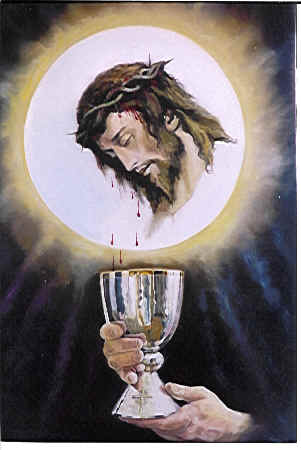









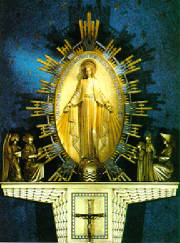

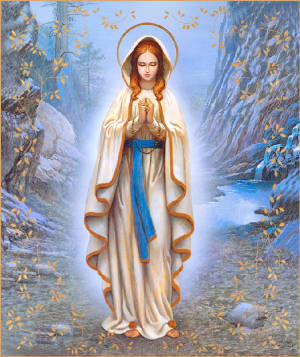
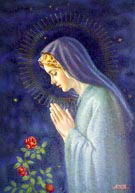





 He became our companion on life's path